Your car’s tires are the only point where your vehicle connects with the road, yet most drivers have no idea how these seemingly simple rubber rings actually function. Understanding how does a car tire work reveals an ingenious engineering solution that’s been refined over a century of automotive development. Despite appearing as little more than an air-filled rubber tube, your tire supports thousands of pounds of vehicle weight while providing traction, comfort, and safety at highway speeds—all through clever physics and material science.
The secret lies in how tires distribute weight through their unique construction. Rather than supporting your vehicle through rigid structure like a wheel, tires use compressed air and tensioned cords to create what’s essentially a flexible support system. This counterintuitive design allows your tires to absorb road imperfections while maintaining consistent contact with the pavement. By the end of this guide, you’ll understand exactly how your tires accomplish these critical tasks and why proper maintenance directly impacts their performance.
The Bicycle Wheel Principle Behind Tire Function
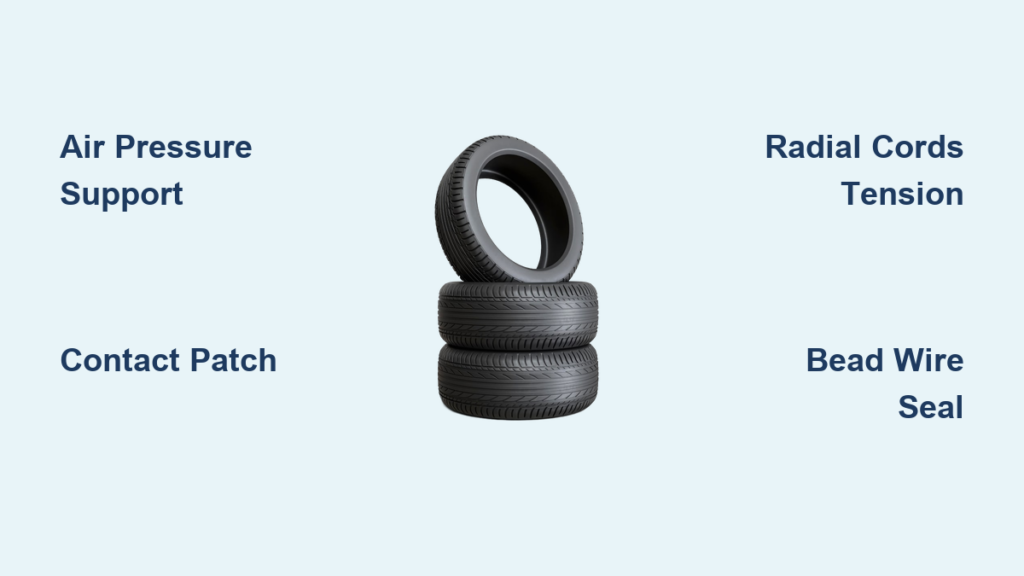
Your car tire operates on the same fundamental principle as a bicycle wheel, though the components are arranged differently. A bicycle wheel relies on spokes under tension to support weight, while the tire uses air pressure to put radial cords in tension. This explains why a flat tire simply buckles under your vehicle’s weight—the cords lose their tension and can no longer support the load.
Why Your Deflated Tire Can’t Support Vehicle Weight
When your tire loses air pressure, the weight of your car pushes the wheel downward, causing the sidewall to buckle and the bottom section to flatten completely against the road. This flattening actually makes the tire grow slightly in diameter as it tries to absorb the extra length of the flattened section. The difference between the undeflected and deflected radius is called counter deflection, and it’s why driving on a flat tire damages both your tire and wheel.
Without proper inflation, the radial cords inside your tire lose tension and can’t behave like the spokes in a bicycle wheel. These cords excel at carrying load in tension but offer almost no resistance to compression, which is why a deflated tire simply collapses. Air pressure creates the structural hoop that forces the tread back into its round shape and puts those critical cords under tension.
How Air Pressure Creates Your Tire’s Structural Integrity
When you inflate your tire to the recommended pressure, the air pushes outward on all surfaces, forcing the tread back into its round shape and putting the sidewall cords into tension. This tension causes the cords to straighten from their naturally skewed position, pulling the tread downward and reducing the flat contact area with the road. The remarkable result? Your wheel is literally hanging inside the hoop formed by the tread, supported entirely by tension in the sidewall cords at the top of the tire.
This explains why proper inflation is so critical—it’s not just about maintaining shape. The air pressure creates initial tension in the cords that prevents fatigue failure as they cycle through different positions during rotation. Without sufficient pressure, the cords experience tension fluctuations that lead to premature failure. Understanding how does a car tire work reveals why checking pressure monthly is your single most important maintenance task.
Your Tire’s Contact Patch: Where Rubber Meets Road
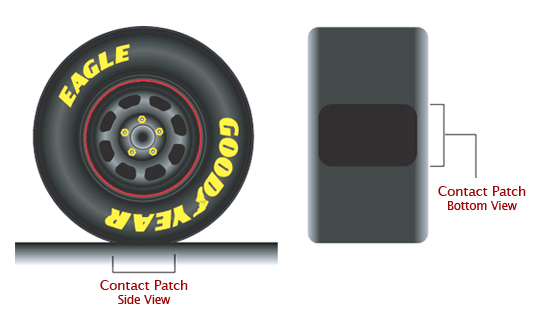
Despite appearing round when viewed from the side, your tire develops a distinct flat spot where it contacts the road surface. This flattened area, called the contact patch, is essential for transferring forces between your vehicle and the pavement. Its size directly impacts your tire’s performance in various driving conditions.
How Weight and Pressure Determine Contact Area
The size of your contact patch depends directly on two factors: the weight pressing down on the tire and the inflation pressure inside. With typical pressures around 32 PSI, a substantial contact patch area is necessary to support your vehicle’s weight. If vehicle weight increases or tire pressure decreases, the contact patch must grow larger—which is why underinflated tires appear noticeably flatter at the bottom.
This relationship has important performance implications. A larger contact patch generally means more traction, which is why racecar drivers sometimes reduce tire pressure for better grip. However, this same enlargement increases rolling resistance and generates more heat, creating trade-offs that tire engineers carefully balance. The contact patch also changes shape during cornering, braking, and acceleration, which is why tire design must account for forces in multiple directions.
Inside Your Tire: Critical Components You Never See
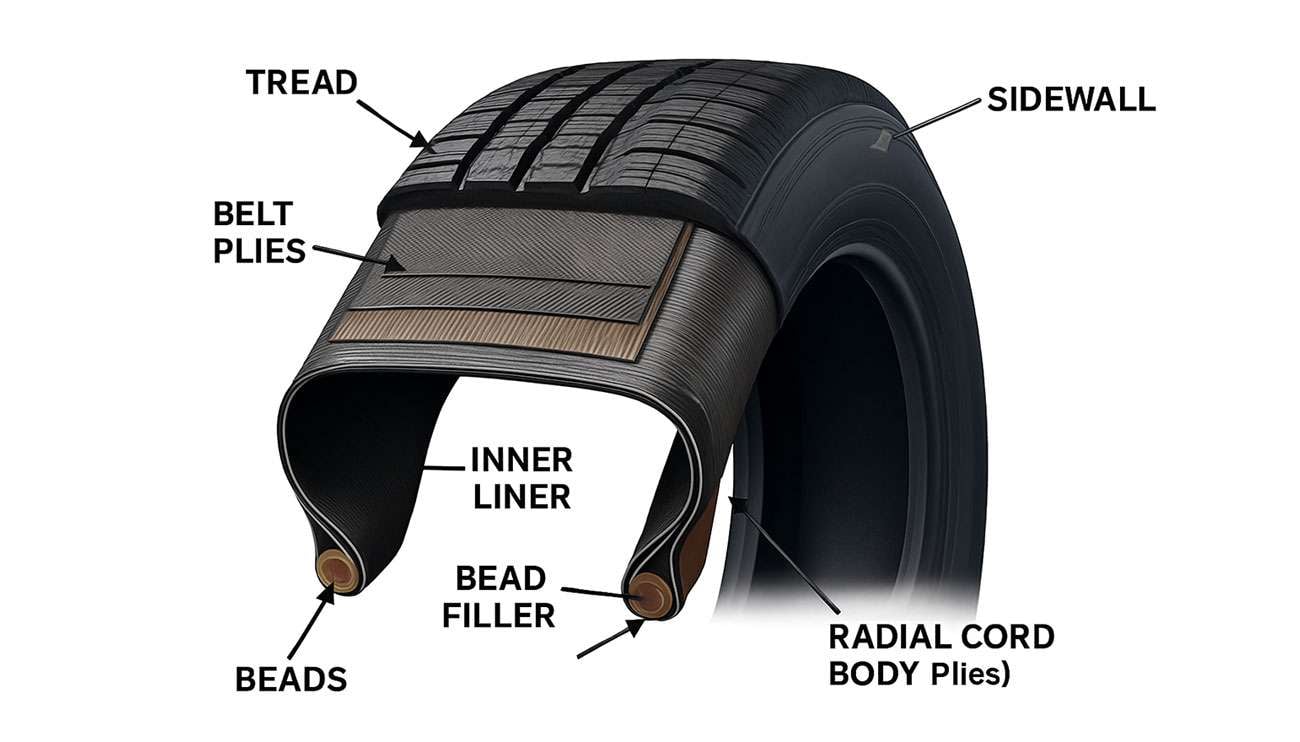
A modern tire contains far more engineering than most drivers realize. Understanding these hidden components reveals why tires can perform their demanding tasks reliably.
The Radial Cords That Support Your Vehicle’s Weight
The sidewall contains radial cords that wrap from one bead wire all the way to the opposite bead wire. These remarkably strong cords give the sidewall its tensile strength, allowing it to support thousands of pounds. Under normal conditions, these cords run radially, but when the tire deflects under load, they skew away from their radial position—a phenomenon called de-radialization.
As your tire rotates, each cord cycles through different positions: purely radial at the top, increasingly de-radialized at the sides, completely squashed at the bottom, and then returning through the same sequence. This constant cycling generates heat, which is why proper inflation minimizes cord movement and extends tire life. Heat is the enemy of tires, and keeping cord movement to an absolute minimum is essential for longevity.
Bead Wire: Your Tire’s Security System
The bead wire represents one of the most critical yet overlooked components. It consists of thick braided steel wire coated with rubber, sitting very close to the wheel rim and extremely strong. The bead wire creates the airtight seal between your tire and wheel rim that maintains inflation pressure.
This is precisely why professional tire installation machines are required to mount tires on rims—tire spoons alone cannot accomplish this task as they can with bicycle tires. The bead wire’s strength ensures your tire stays securely attached to the wheel even under extreme forces, making it a vital safety component you never think about until something goes wrong.
Decoding Tire Specifications for Better Performance
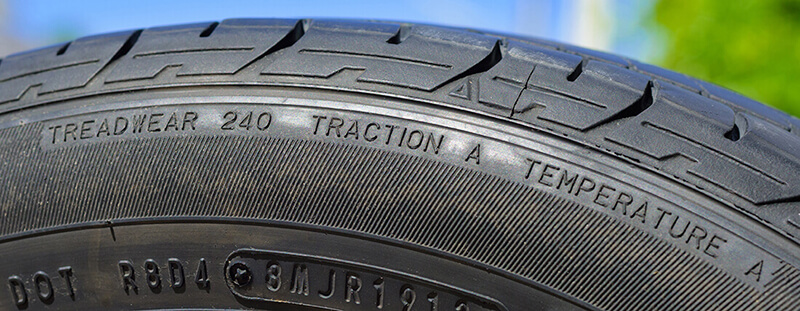
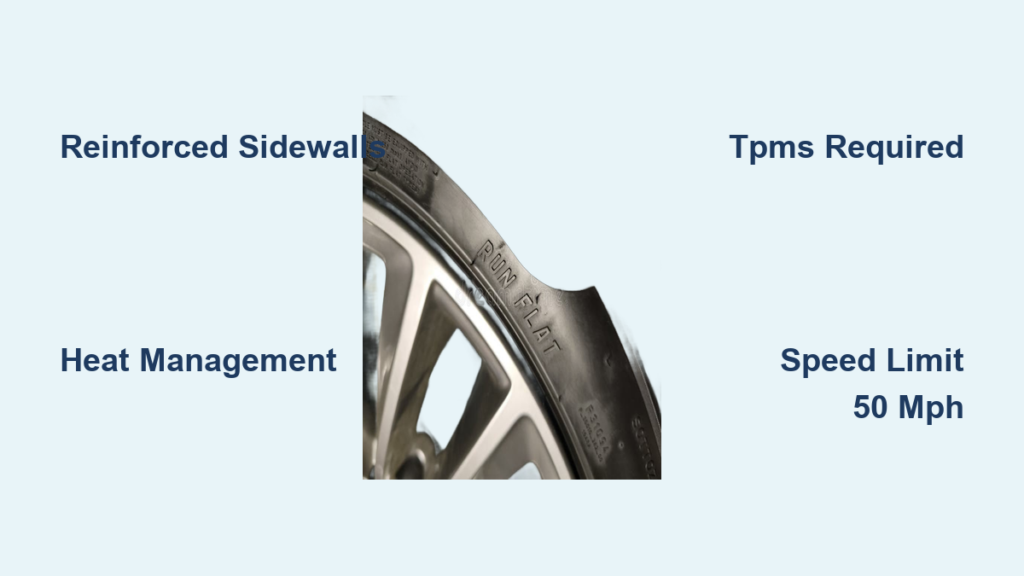
Your tire’s sidewall contains numerous markings that communicate essential specifications. Learning to read them unlocks valuable information about your tires’ capabilities.
Sidewall Markings That Matter Most
The first letter indicates tire type: “P” designates a passenger vehicle tire, “LT” indicates light truck, and “T” denotes temporary or spare tires. Using the correct tire type for your vehicle is essential for safety and proper load capacity.
The three-digit number following the tire type represents tire width in millimeters. The aspect ratio, expressed as a percentage, indicates the tire’s height relative to its width. A tire with a 75 aspect ratio has a height equal to 75 percent of its width. Lower aspect ratios indicate wider tires relative to height, which is why high-performance tires typically have lower aspect ratios—the shorter, stiffer sidewalls provide better lateral stability during aggressive cornering.
The UTQG System: What Those Numbers Really Mean
Passenger car tires bear grades as part of the Uniform Tire Quality Grading system. Tread wear ratings come from controlled testing—higher numbers indicate longer expected tread life. Traction ratings use a scale of AA, A, B, or C, measuring stopping ability on wet surfaces. Temperature ratings also use an A, B, or C scale, measuring heat dissipation capability.
These ratings apply to properly inflated tires that are not overloaded. Underinflation, overloading, or excessive speed can cause dangerous heat buildup regardless of the temperature rating. Understanding how does a car tire work helps you interpret these specifications in the context of real-world performance.
Tire Maintenance That Maximizes Performance and Safety
Proper maintenance ensures your tires perform as designed throughout their service life. Neglecting simple tasks leads to premature wear, reduced safety, and poor fuel economy.
Recognizing Wear Patterns That Signal Problems
Underinflation causes tires to wear more on the outside edges than the center, reduces fuel efficiency significantly, and increases dangerous heat buildup. Overinflation causes excessive wear in the center of the tread and reduces traction. Wheel misalignment causes uneven wear on the inside or outside edges, often with a rough or slightly torn appearance.
Car and Driver recommends replacing tires between six and ten years after purchase, regardless of visible wear. Warranties range from 20,000 to over 100,000 miles, with average tires lasting 40,000 to 60,000 miles when properly maintained. Tire lifespan depends directly on proper inflation, regular rotation, and the driving surfaces most frequently encountered.
Why Checking Tire Pressure Monthly Is Non-Negotiable
The mathematical relationship between pressure and tire stiffness follows Kz = 0.685 × √P × √W × √Kλ, where Kz represents tire stiffness, P is air pressure, and W is tire width. This equation demonstrates that increasing air pressure directly increases tire stiffness, which explains why properly inflated tires deflect less than underinflated ones despite carrying the same load.
For a typical 4,000-pound car with tires having a coefficient of rolling friction of 0.015, the force required to move the tires equals 60 pounds. At 75 mph, tires consume approximately 12 horsepower—power that all converts to heat. Proper inflation minimizes this energy loss while extending tire life. Understanding how does a car tire work makes clear why checking pressure when tires are cold, before driving, is essential for accurate readings and optimal performance.