
Ever stared at the confusing numbers on your motorcycle tire sidewall wondering what they actually mean for your ride? You’re not alone. Motorcycle tire dimensions determine more than just fitment—they directly impact handling, stability, and safety. Understanding these critical measurements helps you select the right replacement tires or explore alternative sizing options without compromising performance. In this guide, you’ll learn exactly how to interpret tire size notation, discover why actual widths vary between brands despite identical size labels, and get practical advice for choosing dimensions that match your riding style and motorcycle requirements.
Choosing the wrong motorcycle tire dimensions can transform your predictable ride into an unstable nightmare. The three-number system on every tire tells a story about width, sidewall height, and wheel compatibility—but many riders misinterpret these specifications with costly consequences. Whether you’re maintaining stock sizing or considering a deliberate change to improve handling, this guide breaks down everything you need to know about motorcycle tire dimensions to make informed decisions that keep you safe on the road.
Read Tire Size Labels Like a Pro
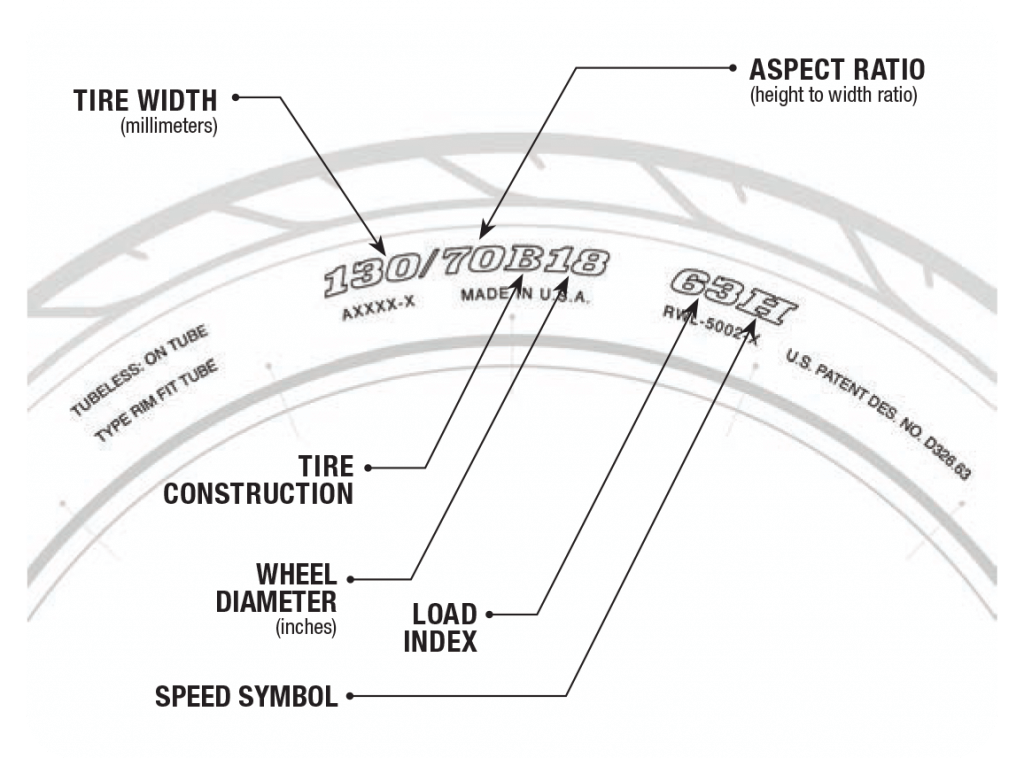
Every motorcycle tire features a standardized size notation that reveals its critical dimensions through three specific numbers. This code, typically formatted as width/aspect ratio-wheel diameter (like 90/90-18), contains everything you need to know about compatibility and performance characteristics.
Break Down the Three-Number Code
When you see 100/90-18 on a tire sidewall, each number serves a distinct purpose. The first figure (100) indicates the nominal tire width in millimeters measured at its widest point when properly mounted and inflated. The second number (90) represents the aspect ratio—meaning the sidewall height equals 90% of the tire’s width. The final number (18) specifies the wheel rim diameter in inches that the tire must match for proper installation.
Understanding this relationship prevents dangerous fitment mistakes. A 100/90-18 tire actually has a sidewall height of 90mm (90% of 100mm), not 90mm wide as many riders mistakenly believe. This precise knowledge helps you anticipate how different sizes will affect your motorcycle’s geometry before you purchase.
Calculate Actual Sidewall Heights Accurately
Sidewall height directly affects ride quality and handling precision, making accurate calculations essential. For a 90/90-18 tire, multiply 90mm width by 0.90 to get 81mm sidewall height (approximately 3.19 inches). A 110/90-18 tire yields 99mm (3.90 inches), while the same width with 80% aspect ratio (110/80-18) produces just 88mm (3.46 inches).
This 11mm difference between 110/90-18 and 110/80-18 significantly alters your motorcycle’s behavior. When upgrading from a stock 90/90-18 (81mm sidewall), installing a 110/90-18 increases ride height by 18mm (0.7 inches)—enough to noticeably change steering geometry and stability characteristics. Always calculate these differences before selecting replacement tires.
Avoid Brand Width Variation Surprises
The most frustrating reality about motorcycle tire dimensions? Identical size labels don’t guarantee identical widths across manufacturers. This critical knowledge prevents clearance issues and unexpected handling changes after installation.
Why Your 100-Series Tire Isn’t Actually 100mm Wide
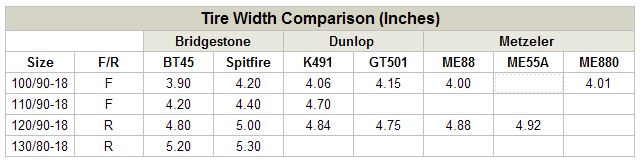
Despite carrying the same “100-series” designation, actual widths vary substantially between brands. Measurements show 100-series tires range from 99mm (3.9 inches) to 107mm (4.2 inches)—an 8% difference that affects fitment and performance. The Bridgestone BT45 100/90-18 measures just 3.9 inches wide, while the Bridgestone Spitfire 100-series stretches to 4.2 inches. Dunlop K491 falls at 4.06 inches, and the GT501 claims 4.15 inches.
This variation means two tires with identical size labels might fit completely differently on your motorcycle. Always verify actual manufacturer specifications before purchasing rather than assuming standardization based on nominal size designations.
Match Width to Your Motorcycle’s Clearance
When selecting replacement tires, consider your motorcycle’s specific clearance requirements. The Bridgestone BT45 110/90-18 often measures similar to the 100-series Spitfire, demonstrating how numeric size designations can be misleading. A tire labeled “110” might physically fit where a “100” supposedly should, depending on the manufacturer.
Before installing wider tires than stock, check critical clearance points: fender edges, brake calipers, chain alignment, and swingarm positioning. Even a 5mm width increase can cause rubbing issues at full suspension compression, potentially damaging both tire and motorcycle components during aggressive riding.
Find Available Sizes by Wheel Diameter

Your wheel diameter determines which motorcycle tire dimensions you can realistically choose from. Understanding availability helps avoid frustrating dead ends when searching for replacements.
Know Which Sizes Actually Exist for Your Wheels
Seventeen-inch wheels offer the widest selection with approximately 37 tire sizes available, making them ideal for sport bikes and modern standards. Eighteen-inch wheels provide about 20 options—common for cruisers and vintage bikes. Sixteen-inch wheels deliver 19 choices, popular for classics and some standards.
Rare sizes create significant challenges: 16.5-inch wheels have only one tire size available, while 11-inch wheels offer just two options. If you own a motorcycle with uncommon wheel diameters, verify tire availability before committing to ownership—some sizes may require special ordering with long wait times.
Identify Practical Size Alternatives
When original sizes become unavailable, consider these strategic substitutions:
- For 18-inch front wheels originally using 90/90-18: 100/90-18 maintains similar geometry with slightly increased contact patch
- For problematic 110/90-18 installations causing headshake: Try 110/80-18 which has comparable width but reduced sidewall height (88mm vs 99mm)
- When 16-inch tires become scarce: Verify if 17-inch wheels with appropriate tires might provide better availability while maintaining similar overall diameter
Always calculate the total diameter difference when considering alternatives—the 110/80-18 (total diameter 656mm) stays much closer to the original 90/90-18 (638mm) than the 110/90-18 (674mm) does.
Fix Handling Issues Caused by Wrong Dimensions
Improper motorcycle tire dimensions create specific handling problems you can diagnose and correct with the right knowledge.
Diagnose Common Dimension-Related Problems
Excessive headshake at speed? Likely caused by increased ride height from taller tires altering steering geometry. A 0.7-inch height increase from switching to higher aspect ratio tires can destabilize handling.
Difficulty initiating turns? Wider tires increase gyroscopic effect and require more steering effort. Test whether your 110-series front tire actually measures significantly wider than stock.
Unexpected mid-corner instability? Some tire profiles create “transition points” where additional lean angle is suddenly required. This often occurs with mismatched aspect ratios between front and rear tires.
Correct Fitment and Handling Issues
When replacing tires, maintain the original overall diameter within 3% to avoid significant geometry changes. For a bike originally using 90/90-18 tires (638mm diameter), acceptable alternatives include:
- 100/90-18 (656mm) – 2.8% increase
- 110/80-18 (656mm) – 2.8% increase
- Avoid 110/90-18 (674mm) – 5.6% increase (too drastic)
If you’ve already installed taller tires causing instability, partially compensate by raising fork tubes in triple clamps. This lowers the front end to restore some original geometry, though it won’t completely eliminate the effects of increased tire diameter.
Select Perfect Dimensions for Your Riding Style
Your ideal motorcycle tire dimensions depend on whether you prioritize stability, agility, or a balance of both characteristics.
Match Dimensions to Your Riding Application
For relaxed touring: Maintain stock dimensions or opt for slightly taller aspect ratios (90 instead of 80) for improved bump absorption. The extra sidewall flex smooths rough roads without sacrificing excessive stability.
For spirited street riding: Consider a slightly wider front tire (100-series instead of 90-series) with matching aspect ratio to increase contact patch while minimizing geometry changes. This provides more grip during aggressive cornering without dramatically altering steering response.
For vintage motorcycle preservation: Stick precisely to original dimensions. Classic frames and suspension systems respond poorly to modern tire profiles, often becoming unstable with contemporary sizing.
Always verify actual manufacturer width specifications rather than relying on nominal size labels. The Bridgestone Spitfire’s 4.2-inch width might overload your vintage fender clearance compared to the Dunlop K491’s 4.06 inches—even though both carry “100-series” designations.
Maintain Tire Dimensions for Optimal Performance
Proper maintenance preserves your carefully selected motorcycle tire dimensions throughout the tire’s lifespan.
Check Critical Maintenance Factors
Inflation pressure: Under-inflation causes width expansion beyond design specifications, altering contact patch shape and reducing stability. Check pressure cold, at least weekly.
Wear patterns: Uneven wear indicates incorrect dimensions or pressure issues. Center wear suggests over-inflation, while shoulder wear indicates under-inflation or excessive width for your application.
Break-in period: Allow 100-200 miles for new tires to reach optimal dimensions as mold release compounds wear away. Avoid aggressive riding during this phase when traction remains inconsistent.
Replace tires showing significant dimensional changes from wear or damage. A tire that has lost 2mm of tread depth effectively functions with a slightly smaller diameter, subtly altering your motorcycle’s geometry and handling characteristics.
Understanding motorcycle tire dimensions transforms confusing numbers into valuable knowledge that enhances your riding experience. By interpreting size notation correctly, accounting for manufacturer variations, and selecting dimensions that match both your motorcycle’s requirements and your riding style, you ensure optimal performance and safety. Always verify actual specifications before purchasing, consider how dimensional changes affect handling geometry, and maintain proper inflation to preserve the dimensions you carefully selected. Your next tire purchase becomes more than just a replacement—it becomes a strategic upgrade to your riding experience.