Nothing ruins a road trip faster than discovering your carefully packed cargo has shifted, damaged, or worse—fallen off your vehicle during transit. Tire straps provide the most reliable solution for keeping your load stable whether you’re transporting luggage on a roof rack, equipment in a truck bed, or even securing spare tires. Understanding how to use tire straps properly isn’t just convenient—it’s a critical safety practice that protects your belongings, your vehicle, and everyone sharing the road with you. This comprehensive guide delivers everything you need to know about selecting, applying, and maintaining tire straps for secure transportation every time you hit the road.
Mastering tire strap techniques takes only minutes but delivers peace of mind for every mile of your journey. Whether you’re a weekend adventurer loading kayaks on your roof rack or a contractor hauling heavy equipment daily, proper strap application prevents costly damage and dangerous road hazards. By the end of this guide, you’ll confidently secure any load with professional-level precision, knowing exactly which strap type to choose, how to achieve optimal tension, and what common mistakes could compromise your cargo’s safety.
How Tire Straps Work to Secure Your Cargo

Tire straps function through a simple yet brilliantly engineered combination of reinforced webbing, secure connection points, and tensioning mechanisms that maintain grip despite road vibration and movement. Unlike bungee cords that lose tension over time or rope that stretches and slips, quality tire straps feature UV-resistant polyester or nylon webbing with reinforced stitching at all stress points—exactly where failure most commonly occurs. The metal components use corrosion-resistant alloys like stainless steel or zinc-plated steel that withstand exposure to rain, snow, and road salt without compromising structural integrity.
What makes tire straps uniquely effective is their specialized tensioning system. Whether using a cam buckle that locks incrementally or a ratchet mechanism that multiplies your hand force, these straps maintain consistent pressure that adapts to cargo movement without loosening. When properly applied, tire straps distribute pressure evenly across your load, preventing damage while creating multiple anchor points that work together to resist shifting in all directions—forward, backward, side-to-side, and vertical movement.
Why Tire Straps Outperform Alternative Securing Methods
Tire straps significantly outperform bungee cords and rope for several critical reasons. Bungee cords lose tension rapidly due to elastic fatigue, especially when exposed to UV radiation and temperature fluctuations. Their hooks often disengage unexpectedly when subjected to vibration, and they provide no reliable way to measure or maintain proper tension. Rope stretches under load, requires complex knotting skills most people lack, and creates uneven pressure points that can damage cargo. Most dangerously, neither method provides clear working load limits, making it impossible to determine if your securing method matches your cargo’s weight.
How Different Strap Mechanisms Create Secure Holds
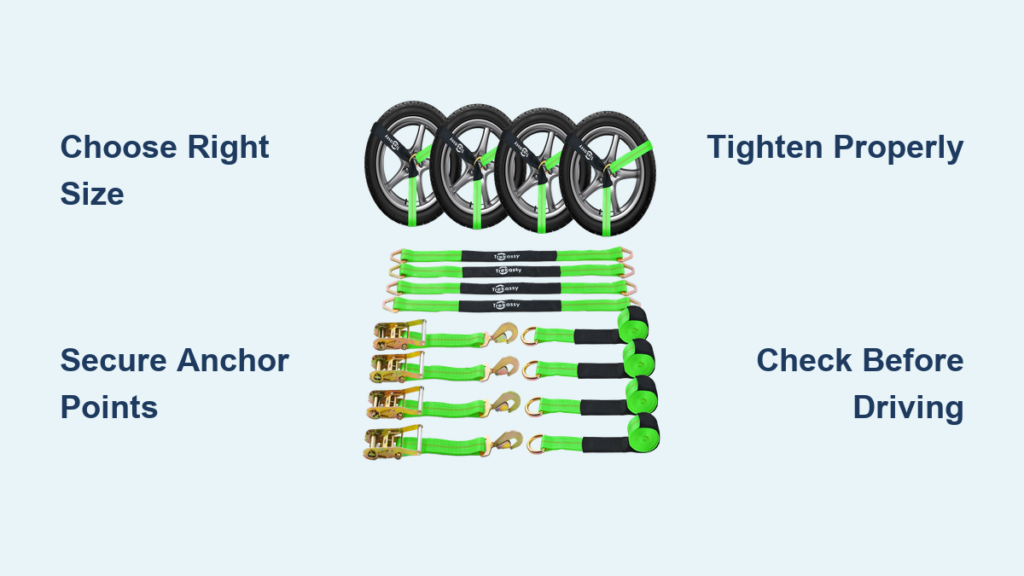
Cam buckle straps work through a simple lever mechanism that allows you to pull the strap tight, then lock it in place with the cam lever. This design provides moderate tension suitable for lighter loads up to 500 pounds. Ratchet straps offer substantially more holding power through a gear mechanism that multiplies your hand force, allowing you to achieve extreme tension for heavy equipment. The ratcheting action clicks incrementally, giving you clear feedback as you tighten. Retractable tire straps use spring-loaded spools that automatically take up slack, keeping your cargo area tidy while providing quick access when needed.
Selecting the Right Tire Strap for Your Specific Load

Choosing the appropriate tire strap starts with understanding your cargo’s weight requirements. Every quality strap displays its working load limit (WLL)—the maximum safe load under normal conditions—and breaking strength. Never confuse these values: the WLL typically represents one-third of the breaking strength, providing a critical safety margin. For example, a strap with a 1,500-pound breaking strength has a 500-pound WLL. Always select straps with a WLL at least double your cargo’s actual weight to account for shock loads from potholes, sudden stops, and highway turbulence.
Matching Strap Width and Length to Your Cargo
Wider straps (2 inches) distribute pressure across larger surface areas, preventing damage to delicate cargo and providing better grip on smooth surfaces. Narrower straps (1 inch) work well for lighter loads but concentrate pressure, potentially causing indentations or damage. Strap length must accommodate your specific vehicle and cargo configuration—too short creates dangerous over-tensioning, while excessive length creates messy, hazardous dangling ends. Measure your typical load setup and add 25% extra length to ensure proper wrapping and tensioning without compromising safety.
Identifying Compatible Anchor Points for Your Vehicle
Your vehicle’s anchor point configuration dictates which hook types will work best. Truck beds often feature stake pockets or D-rings designed for J-hooks, while roof racks typically require S-hooks that fit over crossbars. Trailer tie-down points vary significantly between models, so inspect your specific anchor points before purchasing straps. For maximum versatility, consider straps with interchangeable hook systems or universal designs that adapt to multiple anchor point styles—this flexibility proves invaluable when using different vehicles or trailers.
Step-by-Step Technique for Proper Strap Application
Begin by positioning your cargo correctly before applying any straps. Heavier items should sit low and centered to lower your vehicle’s center of gravity, reducing rollover risk during cornering. Fill voids with lighter items to prevent shifting, and group related items together as single units for more efficient securing. Remove any sharp edges that could cut strap webbing, and consider adding corner protectors where straps contact vulnerable cargo surfaces.
Creating Secure Anchor Connections
Thread strap webbing through anchor points using the “over-under” technique for maximum grip. Pass the strap over the top of an anchor point, then underneath and back over, creating a cinching effect that resists loosening from vibration. This method distributes tension more evenly across the webbing and reduces slippage compared to simple wrap-around connections. For permanent anchor points, install dedicated D-rings that provide secure, non-damaging connection points designed specifically for strap use.
Achieving Optimal Tension Without Damage

Pull strap webbing hand-tight before engaging locking mechanisms—never jump directly to maximum tension. For cam buckles, pull the loose end through the buckle while holding the cam lever open, then release to lock position. The webbing should be snug enough to prevent movement but not so tight that it deforms or crushes cargo. Ratchet straps require cycling the handle to incrementally tighten; stop when you feel substantial resistance and the ratchet begins to click without taking up additional webbing. Proper tension feels firm but not rigid—your cargo should have no play, yet the strap shouldn’t be vibrating tight.
Critical Safety Checks Before Hitting the Road
Work systematically through each strap, tightening in sequence rather than fully tensioning one strap before moving to the next. Start with moderate tension on all straps, then make progressive tightening passes until achieving final tension. This approach ensures balanced securing across your entire load, preventing uneven distribution that causes some straps to bear excessive load while others remain loose.
Testing Your Secured Load for Safety
Apply firm hand pressure to different cargo areas, pushing and attempting to shift items in multiple directions. Listen for any sounds indicating movement or settling, and visually check that all anchor points maintain solid connections. Walk around your vehicle and observe the load from various angles, confirming symmetric positioning and even strap tension. This physical testing catches problems before you encounter them at highway speeds.
The Essential First-Mile Recheck
Stop after the first few miles of travel to re-check all straps, as initial settling and vibration often reduce tension slightly. Many experienced haulers make this re-check a standard practice, stopping at a safe location to inspect and retighten as needed. After this initial re-check, periodic visual inspections during rest stops provide ongoing confirmation of secure cargo throughout longer journeys.
Common Mistakes That Compromise Cargo Security
Using damaged or worn straps ranks among the most dangerous errors in cargo securing. Many continue using straps showing obvious wear because replacement seems unnecessary for light loads. However, degraded straps can fail catastrophically without warning, especially under shock loads from potholes or sudden stops. Replace any strap showing frayed edges, broken threads, deformed hardware, or UV discoloration, regardless of its apparent remaining strength.
Incorrect Hook Attachment Creates Weak Points
Hooks must engage anchor points fully, with the hook gate completely closed and the hook body bearing load on its structural curve, not the gate mechanism. Avoid hooking strap ends to each other, as this creates a weak connection point that typically fails before either strap reaches its rated capacity. Use proper connection hardware designed for the loads you’re securing.
Neglecting Angle Considerations Reduces Effectiveness
Straps connected at shallow angles generate primarily horizontal forces that easily overcome friction and cause sliding. The ideal angle for most applications ranges from 45 to 75 degrees from horizontal, providing both downward pressure and resistance to forward movement. When anchor point locations force shallow angles, use additional straps or reposition anchor points to achieve more effective angles.
Maintaining Your Tire Straps for Long-Term Reliability
Clean straps regularly using mild soap and water, avoiding harsh chemicals that degrade fiber strength. Remove dirt, debris, and contaminants that accelerate wear during use. Allow straps to dry completely before storage, as moisture promotes mold growth and corrosion of metal components. For heavily soiled straps, gentle hand washing preserves webbing integrity better than pressure washing.
Store straps loosely coiled in a dry, temperature-controlled location away from direct sunlight. Avoid compressing straps under heavy items or storing them in tight configurations that deform webbing over time. Hang straps on dedicated storage hooks or place them in containers that allow air circulation. Proper storage prevents kinking, UV damage, and pest infestation that compromise strap reliability.
Perform detailed inspections before each use, not just periodically. Look along the entire length of webbing for cuts, abrasion marks, or fiber damage. Examine stitching at buckles, hooks, and stress points for broken threads or stretched holes. Test locking mechanisms to confirm they engage and release properly. This consistent inspection routine catches developing problems before they cause failures during critical transport situations.
Secure Every Load with Confidence
Mastering tire strap usage transforms cargo transporting from a worrisome activity into a routine task you approach with complete confidence. The key principles—selecting appropriate strap types, matching capacity to load, achieving proper tension, and maintaining equipment—apply across all securing scenarios from casual roof rack loads to professional equipment transport. By following these techniques consistently, your cargo arrives intact and your vehicle handles predictably throughout every journey.
Regular practice builds familiarity with strap behavior under different conditions, allowing you to recognize potential problems before they escalate. Treat your tire straps as essential safety equipment rather than disposable accessories, and they’ll provide years of reliable service. The investment in quality straps and proper maintenance pays dividends in cargo security, peace of mind, and prevention of costly accidents or damages. When you know how to use tire straps correctly, every journey begins with the confidence that your cargo will arrive exactly where and how you intended.