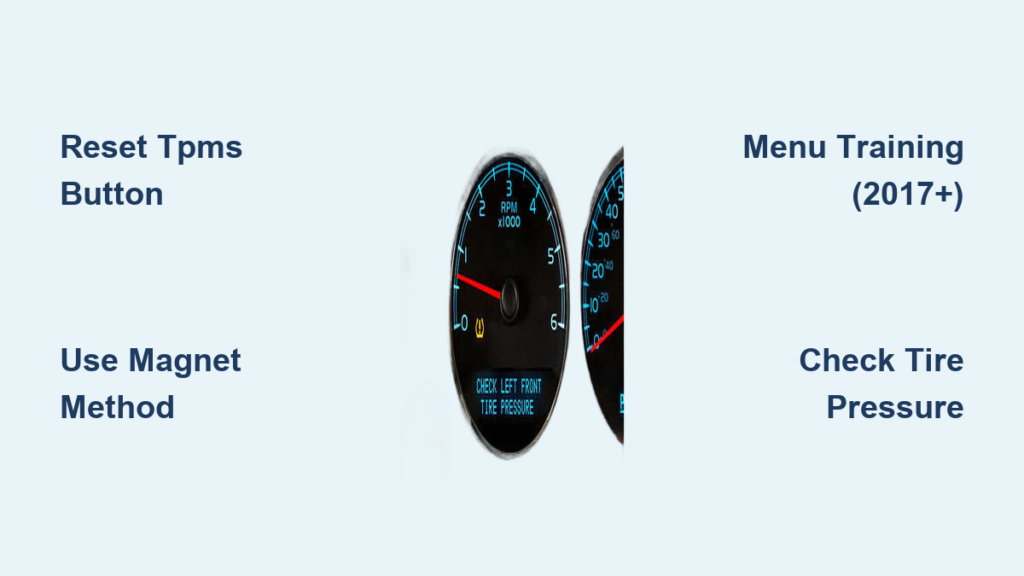
You’ve just replaced your tires or rotated your wheels, and now your Ford’s tire pressure monitoring system (TPMS) warning light won’t turn off. This frustrating situation affects thousands of Ford owners each year who don’t know how to properly train their tire pressure sensors. Without correctly retraining your Ford’s TPMS system after tire service, your vehicle can’t accurately monitor tire pressures, potentially compromising safety and fuel efficiency. In this comprehensive guide, you’ll learn exactly how to train tire pressure sensors Ford models require, eliminating that annoying warning light and ensuring your vehicle maintains optimal tire pressure monitoring.
Why Ford Tire Pressure Sensor Training Fails After Service
When your Ford’s TPMS warning light stays illuminated after tire rotation or replacement, it’s almost always because the system hasn’t been properly retrained to recognize the new wheel positions. Modern Ford vehicles use either direct or indirect TPMS systems that require specific training procedures to function correctly after any tire service. The most common mistake Ford owners make is assuming the system will automatically recalibrate itself as you drive – but without proper training, your vehicle’s computer continues looking for sensors in their previous wheel positions.
How Ford’s TPMS System Identifies Each Wheel Position
Ford vehicles use radio frequency identification to track each tire pressure sensor’s unique signal. When you rotate tires or install new wheels, the system loses track of which sensor belongs to which position. The vehicle’s computer expects Front Left, Front Right, Rear Left, and Rear Right sensors to maintain their positions. Without retraining, your dashboard might show correct pressure for the front tires but display “Low Pressure” warnings for the repositioned rear tires.
Critical Differences Between Ford Model Training Procedures
Not all Ford vehicles use the same TPMS training method. Newer models (2017 and later) typically use the steering wheel menu method, while many older models require the magnet method. Luxury models like Lincolns often have different procedures than F-Series trucks. Attempting the wrong training method for your specific Ford model will result in failed training attempts and persistent warning lights.
Essential Preparation Before Training Your Ford TPMS
Verify Proper Tire Inflation Before Training
Before attempting to train your tire pressure sensors, ensure all tires are inflated to the manufacturer’s recommended PSI, which appears on the driver’s side door jamb sticker. Training with improperly inflated tires causes the system to calibrate incorrectly, leading to false warnings. Use a quality digital tire gauge to verify pressures – don’t rely solely on gas station air machines which are often inaccurate. Check pressures when tires are cold (before driving) for most accurate readings.
Locate Your Specific Ford Model’s TPMS Training Button
Most Ford vehicles have a dedicated TPMS training button located either beneath the steering column, in the glove compartment, or near the headlight switch. Consult your owner’s manual to find the exact location for your model year. Some newer Fords have eliminated the physical button entirely, requiring training through the information display menu instead. Attempting training without knowing your specific method will waste time and frustrate you unnecessarily.
Step-by-Step Ford TPMS Training Methods by Model Year
Training 2017+ Ford Models Using the Steering Wheel Menu
Newer Ford vehicles like the F-150, Escape, and Explorer use an intuitive menu-based system that eliminates the need for special tools:
- Turn ignition to the “ON” position without starting the engine
- Press the “Setup” button on your steering wheel until “Tire Pressure” appears
- Press “Reset” until “Train Tires” appears, then confirm with “OK”
- Begin with the driver’s side front tire – hold a magnet (or use the valve stem) over the sensor location until you hear a horn chirp
- Repeat for passenger front, driver rear, and passenger rear tires in sequence
- The system automatically saves when complete – verify by checking the display
Pro Tip: Keep the process moving quickly – most systems time out after 30 seconds between tires. Have your magnet ready before starting the menu sequence.
Training Pre-2017 Ford Models Using the Magnet Method
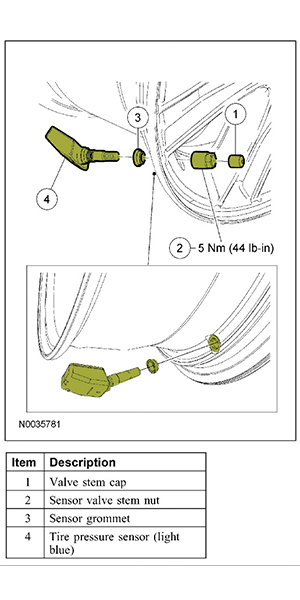
Older Ford vehicles require the traditional magnet-based sensor activation:
- Inflate all tires to recommended pressure and turn ignition to “ON”
- Locate and press the TPMS reset button until the TPMS warning light blinks slowly
- Begin with driver’s side front tire – place a strong magnet against the valve stem
- Wait 3-5 seconds until you hear a horn chirp confirming sensor recognition
- Move to passenger front, then driver rear, and finally passenger rear tires
- Complete the sequence within two minutes or the system will time out
Warning: Using a weak magnet or holding it too far from the valve stem causes failed training. Automotive supply stores sell specialized TPMS magnets that work reliably.
Ford Models Requiring OBD-II Scanner Training
Certain Ford commercial vehicles and specialty models like the Transit Van require professional-grade equipment:
- Connect a Ford IDS or compatible OBD-II scanner to the diagnostic port
- Navigate to “Service Functions” > “TPMS” > “Relearn”
- Follow on-screen prompts to activate each sensor in sequence
- The scanner displays real-time sensor IDs as each is recognized
- Complete the process within the system’s 5-minute time limit
Important: Attempting manual training on these models will fail. Many auto parts stores offer free TPMS relearn services for Ford vehicles that require scanner training.
Troubleshooting Failed Ford TPMS Training Attempts
When Your Ford Won’t Enter Training Mode
If your vehicle won’t enter TPMS training mode despite following procedures:
- Check that your ignition is in the correct position (some models require “RUN” not “ACC”)
- Verify all doors are completely closed – even a slightly ajar door prevents training
- Ensure the parking brake is engaged (required on many Ford models)
- Try disconnecting the negative battery terminal for 15 minutes to reset the system
Solving Partial Training Failures (Only Some Tires Recognized)
When only certain tires register during training:
- Clean valve stems thoroughly – dirt can block sensor signals
- Replace weak sensor batteries (typically last 5-7 years)
- Check for aftermarket wheel spacers interfering with sensor signals
- Drive at 20+ mph for 10 minutes to wake up dormant sensors before retraining
Preventing Future Ford TPMS Training Issues
Proper Tire Rotation Protocol for Ford Vehicles
To avoid repeated TPMS training after each rotation:
- Maintain original wheel positions (front-to-back only, no cross-rotation)
- Document sensor positions before removing wheels
- Use colored valve stem caps to track positions
- Train the system immediately after rotation while vehicle is still lifted
When to Replace Ford TPMS Sensors Proactively
Ford TPMS sensors typically last 5-7 years before battery depletion causes failures. Replace sensors in sets of four when:
- Sensors are over 5 years old (check manufacture date on valve stem)
- You notice inconsistent pressure readings
- The system requires frequent retraining
- Winter temperatures consistently trigger false warnings
Final Verification and Maintenance Tips
After completing the training process, take these critical verification steps:
- Drive at 15+ mph for 2 minutes to allow full system initialization
- Check the information display to confirm all tires show correct pressure
- Verify no warning lights remain illuminated after 10 minutes of driving
- Recheck pressures after 24 hours to ensure stable readings
For ongoing maintenance, reset your TPMS system every time you adjust tire pressures significantly, especially during seasonal temperature changes. Keep a TPMS training checklist in your glove compartment for quick reference during future tire services.
Pro Tip: Ford’s system typically relearns positions automatically after driving 20+ miles if initial training fails – but don’t rely on this as your primary method since it’s inconsistent.
By following these precise Ford-specific training procedures, you’ll maintain accurate tire pressure monitoring without unnecessary service visits. Properly trained TPMS sensors improve fuel economy by up to 3%, extend tire life, and most importantly, keep you safer on the road by providing accurate low-pressure warnings when they matter most.