That amber tire pressure warning light on your Kia Carnival dashboard can be more than just an annoyance—it’s a critical safety alert that shouldn’t be ignored. When the tire pressure monitoring system (TPMS) activates, it means one or more of your tires has dropped below the manufacturer’s recommended pressure level. But here’s the frustrating part: even after you’ve properly inflated your tires, that warning light often stays illuminated, leaving you wondering how to reset tire pressure sensor Kia Carnival models require. Understanding the precise reset procedure is essential for every Carnival owner, as improper resets can leave you without critical safety warnings when you actually need them.
The Kia Carnival’s TPMS uses four sophisticated sensors—one embedded in each wheel—that continuously monitor both pressure and temperature inside your tires. When these sensors detect a pressure drop below the standard level, they transmit signals to your vehicle’s computer, triggering that familiar amber warning light. Resetting becomes necessary after tire rotations, replacements, seasonal pressure adjustments, or when temperature fluctuations trigger false alerts. This guide provides the exact steps to reset your Kia Carnival’s tire pressure sensor system properly, explains why warnings sometimes persist, and helps you determine when professional service is truly needed.
Verify Correct Tire Pressure Before Resetting
Before attempting any reset procedure, you must confirm all four tires are inflated to the exact specifications for your Kia Carnival model. Incorrect tire pressure is the number one reason reset attempts fail—trying to reset with underinflated tires is like trying to save a document that hasn’t been properly typed.
Your Kia Carnival’s required pressure depends on your wheel size: vehicles with 17-inch wheels need 37 psi (240 kPa), while those with 19-inch wheels require 36 psi (250 kPa). Never guess these values—check the tire inflation pressure label located on your driver’s side center pillar outer panel for your specific vehicle’s requirements.
For the most accurate reading, measure tire pressure when your vehicle has been stationary for at least three hours and driven less than one mile during that time. This “cold tire” measurement provides the baseline the TPMS system uses. If you’ve recently driven, temporarily add 3-4 psi to account for heat expansion, then adjust back to specifications once tires have cooled completely.
Locate Your Kia Carnival’s TPMS Reset Button

Finding the TPMS reset button on your Kia Carnival can be surprisingly tricky, as it’s often partially concealed beneath the steering column. Many owners waste valuable time searching for this small button without success. Check carefully around the instrument panel area and under the steering wheel—it’s typically positioned within easy reach of the driver but may be hidden by trim pieces.
Some newer Kia Carnival models have moved the reset function to the infotainment system rather than using a physical button. If you can’t locate a physical button after thorough searching, consult your owner’s manual for model-specific instructions on accessing the reset function through your vehicle’s touchscreen interface.
Once you’ve found the reset button, prepare for the procedure by ensuring your vehicle is parked on a level, firm surface with the engine running. The reset process will not activate if pressed while driving—complete immobilization with the engine running is essential for success.
Execute the Standard Button Reset Procedure
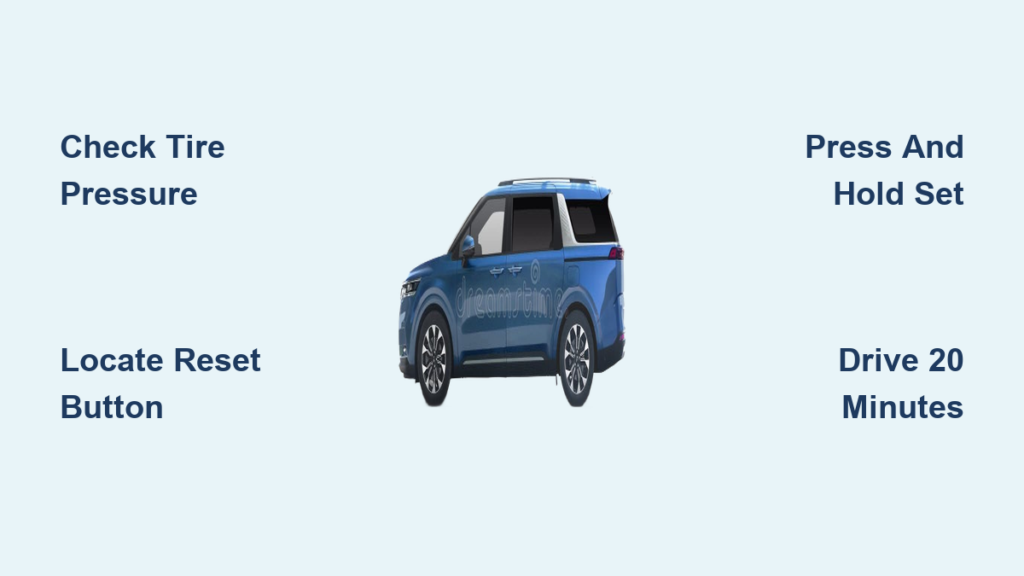
With your engine running and all tires properly inflated, you’re ready to initiate the TPMS reset. Press and hold the TPMS SET button for approximately three seconds until you see the reset process beginning. On vehicles equipped with a supervision cluster, look for the “Tire pressures stored” message appearing on your instrument panel, confirming the system has accepted the new reference values.
After releasing the SET button, the low tire pressure indicator should blink for four seconds and then turn off, signaling a successful reset. This blinking period represents the system processing and storing the new pressure values from each wheel sensor.
Following the button reset, drive your Kia Carnival for approximately 20 minutes to complete the system’s learning process. During this drive, the TPMS performs automatic location learning, correlating sensor signals with wheel positions. Without this driving period, the warning light will likely reappear despite proper pressures being stored.
Apply the Highway Driving Reset Alternative

When the TPMS SET button is difficult to access or you’re unsure of its location, the highway driving method provides an effective alternative. Drive your Kia Carnival at or above 50 mph (approximately 80 km/h) for at least 10 minutes. This sustained speed allows the TPMS sensors to transmit their signals repeatedly—every 16 seconds in learning mode—while the vehicle’s system correlates these signals with wheel position data from the ABS system.
For stubborn warning lights that persist after inflation and button resets, extend your highway driving to 20 minutes or more. Some Carnival owners have reported success with drives exceeding 10 minutes at highway speeds, with one noting their warning cleared after such a drive even when tires were at 35 psi rather than the recommended 36 psi. This suggests the system may clear warnings based on consistent pressure across all tires rather than requiring exact specification pressure in every case.
The automatic location learning function performs comprehensive checks for every driving position after the vehicle has been stopped or parked for more than 19 minutes. This explains why multiple short trips often fail to clear warnings—the system doesn’t have sufficient continuous driving time to complete its learning cycle in shorter intervals.
Diagnose Persistent TPMS Warning Lights
Even after proper inflation and reset procedures, some Kia Carnival owners experience TPMS warning lights that remain illuminated for extended periods—sometimes weeks. This persistent illumination doesn’t necessarily indicate a failed sensor; it often means the system requires additional time or driving cycles to recognize and store updated pressure values.
When the warning light persists despite correct tire pressures:
– Verify pressures with a reliable gauge (not just the gas station air pump)
– Ensure all four tires are within specification (37 psi for 17-inch wheels, 36 psi for 19-inch)
– Check for small pressure differences between tires that can prevent system clearance
If pressures are correct and the light remains on after multiple driving cycles, the system may be detecting a fault condition in its external operating environment. When the TPMS detects issues like low battery voltage or abnormal vehicle speed signals, the warning lamp blinks for about one minute and then turns on continuously. This fault warning should resolve automatically once the system completes 30 or more ignition cycles without detecting fault signals.
Address Temperature-Related TPMS Alerts
Cold temperatures frequently trigger TPMS warnings as tire pressure naturally decreases with temperature drops. This is particularly common during winter months in colder regions, where temperature changes of 20-30 degrees Fahrenheit can cause pressure losses of 5-10 psi in otherwise healthy tires.
When temperature changes trigger a warning:
1. Fill each tire to the specified pressure—37 psi for 17-inch wheels or 36 psi for 19-inch wheels
2. Drive for 20 minutes to allow the system to recognize the new pressure values
3. If the warning persists, perform the button reset procedure
Sudden temperature fluctuations, particularly during transition seasons, can also cause alerts even when pressure remains within acceptable ranges. The TPMS monitors both pressure and temperature inside each tire, and significant temperature changes can trigger warnings as the system interprets thermal contraction as a potential pressure leak.
Pro Tip: Check tire pressures monthly during extreme weather seasons and maintain pressures near the upper end of the specification range during winter months to reduce cold-weather alerts while remaining within safe operating parameters.
Recognize When to Replace a Faulty TPMS Sensor

A flashing tire pressure light typically indicates a sensor battery failure or sensor malfunction rather than simple pressure loss. This differs from a solid warning light, which generally indicates low tire pressure requiring inflation. Flashing warnings require professional diagnosis and service, as sensor battery replacement or full sensor replacement requires specialized equipment.
TPMS sensor replacement involves:
– Removing the wheel and tire assembly
– Accessing the sensor mounted inside the wheel (secured with a T10 torx screw)
– Carefully removing the sensor without damage
– Installing the new sensor with proper lubricant (soap water or YH100 tire lubricant)
– Completing the sensor learning process through driving or professional equipment
Sensor batteries (CR2032 type) typically last several years under normal conditions. When batteries begin to fail, the system may display inconsistent behavior or warning patterns. A consistently flashing warning light that doesn’t respond to reset procedures often indicates a sensor reaching end-of-life.
Master Kia Carnival TPMS Maintenance Best Practices
Preventing unnecessary TPMS warnings requires consistent maintenance habits. Check tire pressures monthly using a reliable gauge, and adjust for temperature changes by adding approximately 1 psi for every 10 degrees Fahrenheit of temperature increase. During seasonal transitions, verify pressures more frequently as temperature swings can cause significant pressure fluctuations.
When performing tire service—including rotation, replacement, or repair—always complete the TPMS reset procedure afterward. Failure to reset after tire service may cause the system to function improperly, potentially leaving you without warning during actual pressure loss events.
Schedule professional TPMS inspection if:
– Warning lights appear frequently without clear cause
– Multiple reset attempts fail to clear indicators
– Sensors are more than five years old
– You notice inconsistent warning behavior
Critical Takeaways for Successful TPMS Reset

Resetting the tire pressure sensor on your Kia Carnival requires three precise steps: proper tire inflation to 37 psi (17-inch wheels) or 36 psi (19-inch wheels), the correct reset procedure, and adequate driving time for system learning. Begin by inflating all tires to specification, then press and hold the SET button for three seconds with the engine running. Drive for approximately 20 minutes afterward to complete the learning process.
For persistent warnings that don’t clear after proper reset procedures, extended driving at highway speeds often resolves the issue. Remember that solid lights usually indicate pressure issues requiring inflation and reset, while flashing lights suggest sensor problems requiring professional service. Most warnings clear within minutes to hours of proper intervention, though some cases may persist for days before resolving spontaneously during normal driving. By following these precise steps, you’ll ensure your Kia Carnival’s tire pressure monitoring system functions correctly, keeping you safely informed about your tire conditions.