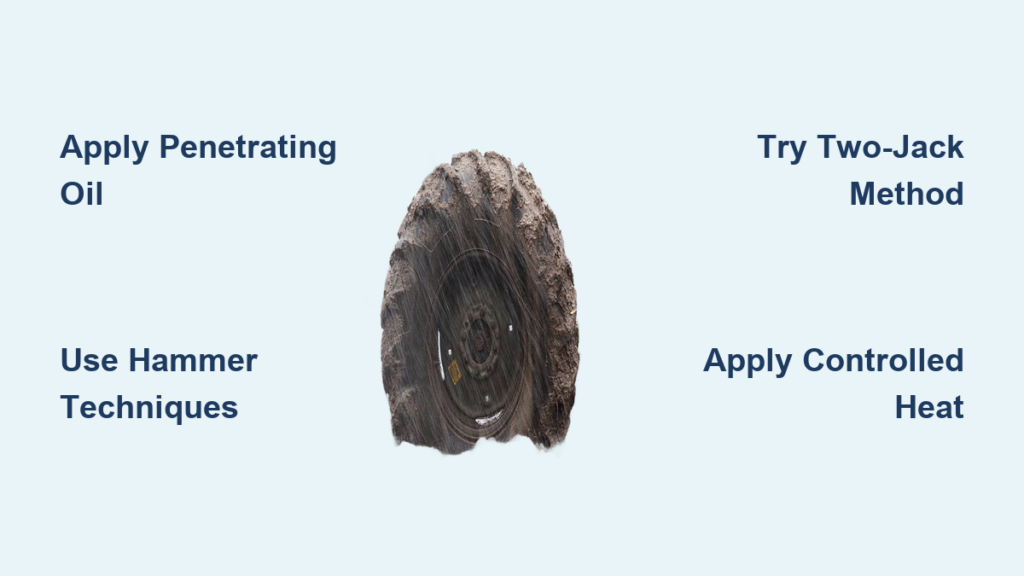
You’ve loosened all the lug nuts, raised your vehicle on jack stands, and now you’re staring at a tire that refuses to budge. That seized tire situation turns a routine tire change into a frustrating battle against rust and corrosion. Millions of drivers face this problem annually, especially in regions where road salt accelerates metal bonding between wheel and hub. The good news is that most seized tires can be freed with the right approach, proper tools, and a bit of patience. This guide reveals the exact techniques professional mechanics use to remove stuck wheels without causing damage to expensive components or risking personal injury.
Understanding why wheels seize explains why standard removal methods fail. When moisture and road salt penetrate the microscopic gap between your wheel and hub, electrochemical corrosion begins bonding the dissimilar metals together. Over time, temperature cycles of expansion and contraction press these surfaces together with increasing force—creating a bond as strong as weld. Vehicles stored for extended periods face even greater risk as moisture works uninterrupted into the interface. But don’t reach for the tow truck just yet; most seized tire situations yield to systematic treatment using the methods outlined here.
Why Your Tire Won’t Budge Off the Hub
The root cause of a seized tire is galvanic corrosion forming between dissimilar metals at the wheel-hub interface. When you combine aluminum or steel wheels with a steel hub, introduce road salt as an electrolyte, and add time, you create perfect conditions for molecular bonding. This isn’t just surface rust—it’s a chemical fusion that locks the wheel in place with surprising strength.
Northern climates see the most severe cases as road salt creates ideal corrosion conditions. Coastal regions face similar challenges from salt air exposure. What starts as a thin moisture layer becomes concentrated brine as it evaporates, penetrating deeper into the interface with each temperature cycle. The wheel and hub expand and contract at different rates during seasonal changes, pressing the mating surfaces together with increasing force. After three or four winters, a wheel that was slightly stuck may become completely immovable without specialized techniques.
Essential Tools for Seized Tire Removal

Never attempt seized tire removal without these critical tools assembled and ready:
- Two jack stands rated for your vehicle’s weight: Never work under a vehicle supported only by a hydraulic jack—jack stands provide reliable safety support. Position them on solid, level ground under designated frame points.
- Three types of hammers: A 2-3 pound club hammer for moderate force, a rubber mallet for aluminum wheels, and a sledge hammer for severe cases. Each serves a specific purpose in the removal sequence.
- High-quality penetrating oil: PB Blaster or WD-40 Specialist with extension nozzle for precise application into the wheel-hub gap.
- Cedar 2×4 wood blocks: Soft wood protects wheel surfaces during impact methods while distributing force evenly.
- Breaker bar with appropriate socket: Provides maximum torque for lug nuts and specialized removal tools.
Having these tools within arm’s reach prevents dangerous trips to the garage mid-procedure. Many failed removal attempts stem from improvising with inadequate equipment rather than the severity of the seizure itself.
Penetrating Oil Application That Actually Works
Most DIYers apply penetrating oil incorrectly, rendering it ineffective against severe seizures. Follow this proven technique:
- Spray oil generously around the entire wheel circumference where it meets the hub, using the extension nozzle to target the actual gap between mating surfaces
- Reapply oil every 15-20 minutes for at least 2 hours, or better yet, overnight for severe cases
- Apply gentle heat with a hair dryer after oil application to accelerate penetration (avoid direct flame near tires)
Critical mistake to avoid: Don’t just spray the outer edges and expect results. The oil must reach the actual bonding interface, which requires patience and multiple applications. For best results, combine oil treatment with mechanical agitation—strike the wheel lightly every time you reapply oil to help the lubricant work deeper into the corrosion.
Hammer Techniques That Break the Bond Without Damage
The right hammer technique breaks corrosion bonds while protecting your wheel finish:
Club Hammer Criss-Cross Method
With two lug nuts left partially threaded (as safety restraints), strike the rim in this sequence: 12 o’clock → 7 o’clock → 3 o’clock → 10 o’clock → 5 o’clock. This pattern distributes force evenly around the circumference. Work from both sides of the wheel if clearance permits, applying firm but controlled strikes. Alternate sides every 3-4 strikes to prevent localized stress.
Rubber Mallet Sidewall Technique
For expensive aluminum wheels, strike the tire sidewall (not the rim) at 3 and 9 o’clock positions while rotating the wheel between strikes. The rubber absorbs impact energy while transmitting enough force to break moderate corrosion bonds. This method combines well with overnight oil treatment for sensitive wheels.
Pro Tip: The Kicking Method
With the vehicle supported and lug nuts loosened but engaged, brace your back against a wall and kick the wheel firmly at 3 and 9 o’clock positions. Your body weight generates surprising force through this technique, often freeing wheels that resisted tools. Many mechanics consider this their secret weapon for moderate seizures.
Two-Jack Separation Technique for Stubborn Tires
When hammer methods fail, this controlled hydraulic approach often succeeds:
- Position a floor jack beneath the wheel to support its weight
- Place a screw jack against a solid structural point like a shock mount
- Apply slow, steady upward pressure with the screw jack while the floor jack maintains contact
The mechanical advantage of the screw jack generates substantial separating force directly at the interface. Listen for creaking or popping sounds indicating the corrosion bond fracturing. This method works particularly well when combined with penetrating oil treatment, as the controlled force prevents sudden wheel release that could cause injury.
Driving Method That Loosens Seized Tires Without Tools
One of the most effective yet overlooked techniques exploits your vehicle’s natural movement:
- Loosen lug nuts by 3-4 full turns (but don’t remove them)
- Drive forward and backward in short bursts on loose gravel or dirt
- Turn steering fully left and right to apply multidirectional force
- Immediately attempt removal after driving while the wheel remains loose
This method succeeds because vehicle vibration and suspension movement work the corrosion bond loose far more effectively than static methods. Front-wheel-drive vehicles benefit from steering movement that applies torque in different directions. Many users report success with this technique when all other methods failed, making it an essential first attempt before resorting to more aggressive approaches.
Heat Application That Breaks Corrosion Bonds Safely
Controlled heat creates differential expansion between wheel and hub:
- Apply heat with a propane torch to the outer wheel edge where it meets the hub
- Move continuously to avoid hot spots, heating for 30-60 seconds per section
- Allow slight cooling before attempting removal (the contraction helps break the bond)
Critical safety note: Never heat near brake components, tires, or plastic parts. Use heat shields to protect vulnerable areas. Aluminum wheels require less heat than steel—overheating can cause warping. This method should be your last DIY option before seeking professional help, as improper application risks component damage.
Prevent Future Seized Tires During Reinstallation
Prevention requires proper surface preparation and lubrication:
- Thoroughly clean both wheel mounting surface and hub flange with wire brush
- Remove all rust, corrosion, and old grease to ensure clean metal-to-metal contact
- Apply thin layer of copper-based anti-seize compound to hub flange only
- Never apply lubricant to lug nut threads—this creates dangerous torque inconsistencies
Regular tire rotations provide opportunities to inspect for early corrosion. Vehicles in salt-prone areas benefit from anti-seize reapplication every 6-12 months. This simple maintenance prevents 95% of future seizure problems, saving you hours of frustration during your next tire change.
Critical Safety Steps Before Attempting Removal
Never skip these essential safety precautions:
- Always support the vehicle on jack stands, never just a hydraulic jack
- Place the spare tire under the rocker panel as secondary support
- Wear safety glasses and work gloves during all impact methods
- Keep fingers clear of potential pinch points between wheel and hub
- Leave 2-3 lug nuts partially threaded until the wheel breaks free
The most common injury during seized tire removal comes from the wheel suddenly releasing and shifting unexpectedly. These precautions prevent serious foot injuries, crushed fingers, and vehicle collapse that send dozens to emergency rooms each year.
When home methods fail after multiple attempts, professional intervention becomes the wisest choice. Tire shops have specialized equipment like hydraulic wheel pullers and controlled heating systems that can address severe seizures without component damage. The cost of professional removal typically ranges from $50-$150—far less than replacing a damaged hub or wheel from aggressive DIY attempts. Remember: a seized tire is always fixable with the right approach, patience, and respect for the forces involved.