That quarter rattling in your cup holder isn’t just spare change—it’s your most critical tire safety tool. When sudden rain turns roads into skating rinks, worn tires lose traction faster than you can hit the brakes. Knowing exactly how to measure tire tread with a quarter gives you instant insight into whether your tires will grip or slide when it matters most. Most drivers wait for visible wear bars or dangerous vibrations before checking tread depth, but by then, your stopping distance could be 40% longer on wet pavement. In this guide, you’ll master the quarter test that takes less than 30 seconds, understand why 4/32″ tread depth is your safety threshold, and learn the common mistakes that make this simple check dangerously inaccurate.
Why Your Quarter Outperforms Fancy Tread Gauges for Quick Checks
Most drivers don’t realize the quarter test beats expensive gauges for everyday safety checks. While professional tools measure exact millimeters, the quarter instantly shows if you’ve crossed the critical 4/32″ safety threshold where hydroplaning risk spikes. New tires start with 10/32″ of tread, but once they wear down to 4/32″, your stopping distance on wet roads increases dramatically. The quarter’s design makes this visual: George Washington’s head sits at exactly 4/32″ from the edge. When you insert it head-first into your tire’s deepest groove, the coin becomes a binary safety indicator—no measurements needed. This method works because Washington’s hairline and chin create clear visual markers that even children can interpret, turning a technical check into a glance-and-go assessment.
What to Do Before Inserting Your Quarter
Never test tires that are hot from driving—wait at least 30 minutes after your last trip. Hot rubber expands, giving falsely deep readings. Park on level ground away from traffic, and engage your parking brake. Focus on the tire’s outer shoulder and inner edge where wear accelerates fastest, not just the center tread. Rotate your tires while checking—most vehicles wear front tires faster than rears. If you spot uneven wear patterns like cupping or feathering, that indicates alignment issues needing professional attention regardless of tread depth.
Why You Must Check Multiple Tread Grooves
Tread wears unevenly across the tire surface. Checking only one spot could miss dangerous bald patches. Insert your quarter in at least six locations per tire: outer edge, center, and inner edge on both the left and right sides of the tread pattern. Pay special attention to the tire’s outside shoulder—the part that grips during turns—which wears 20-30% faster than other areas. If Washington’s head shows visible in three or more test points, replace that tire immediately even if other spots seem adequate.
How to Read Washington’s Head for True Tread Depth
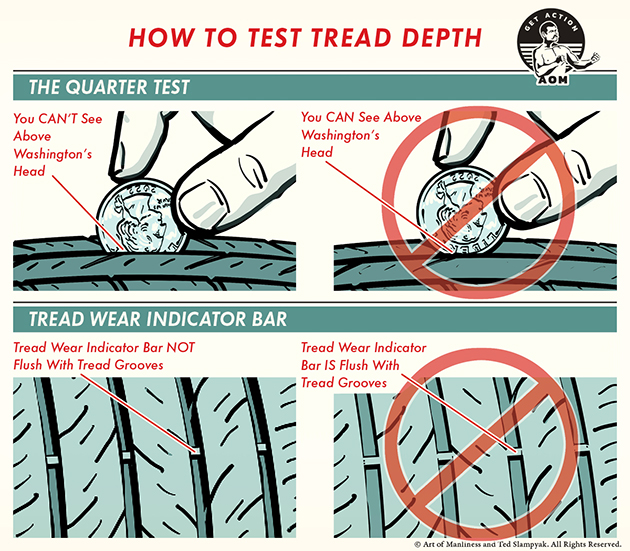
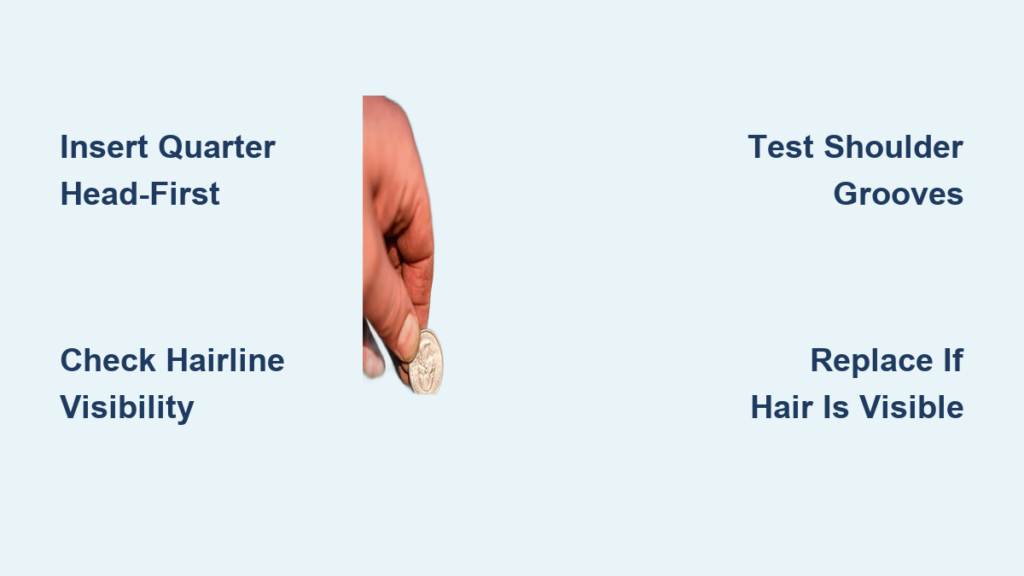
The quarter test isn’t about covering the whole coin—it’s specifically about George Washington’s head depth. Hold the quarter with Washington’s head upside down and facing you. Slide it straight into the deepest part of the tire’s main groove. Now observe critically:
- SAFE: If the top of Washington’s hairline remains buried, your tread exceeds 4/32″
- DANGEROUS: If you see any part of his hair above the tread surface, depth is below 4/32″
- CRITICAL: If his entire head is visible, tread is near or below 2/32″ legal minimum
Don’t confuse the coin’s rim with tread depth—the critical marker is specifically Washington’s hairline, which sits precisely 4/32″ from the coin’s edge. Many drivers mistakenly use the coin’s full thickness (which is 5/32″), creating false security. Your eyes should focus on where the rubber meets the coin just above his forehead.
What to Do When Washington’s Head Is Partially Visible
Partial visibility requires immediate action. If you see the top 1/8″ of his hair but not the full hairline, your tread is between 3/32″ and 4/32″. This is the danger zone where wet-weather stopping distance increases 25% compared to new tires. For daily drivers, schedule tire replacement within 1,000 miles. For highway commuters or those in rainy climates, replace immediately. Never wait for the legal minimum of 2/32″—at that depth, your tires have lost 80% of their wet-weather traction capacity.
Why 4/32″ Matters More Than Legal Minimums

Most drivers don’t realize legal tread minimums (2/32″ in all 50 states) are survival thresholds, not safety standards. At 4/32″, tires still maintain 50% of their original hydroplaning resistance—but drop to just 20% at 2/32″. The quarter test’s 4/32″ standard comes from tire manufacturer testing showing significant traction loss below this point. In independent wet-braking tests, vehicles with 4/32″ tread stopped 85 feet shorter than those at 2/32″ at 70 mph. That’s the length of two school buses—enough to avoid a collision. Always use the quarter’s 4/32″ standard for replacement decisions, not the penny test’s 2/32″ threshold.
How Weather Changes Your Safety Threshold
Your quarter test results mean different things in different conditions. In rainy climates, replace tires immediately when Washington’s hair becomes visible—even if above 4/32″. Snow requires even deeper tread; anything below 6/32″ struggles to bite into packed snow. For highway drivers averaging 65+ mph, visible hair means replace within 500 miles regardless of conditions. City drivers below 45 mph can stretch to 1,000 miles but must avoid heavy rain. Never drive on tires showing Washington’s full head (≤2/32″) in any weather—your insurance may deny claims after accidents caused by bald tires.
Penny Test vs. Quarter Test: Why Quarters Win for Safety
Many still use the penny test (Lincoln’s head at 2/32″), but this dangerously overestimates safe tread depth. The penny test only confirms if tires are legally drivable—not if they’re actually safe. At 2/32″, tires have just 20% of their original wet-weather capability. The quarter’s 4/32″ standard gives you 50% more stopping power. When comparing both tests side-by-side in rain simulations, quarter-test-passing tires reduced hydroplaning incidents by 63% compared to penny-test-only tires. Always keep a quarter in your glovebox—not a penny—for accurate safety checks. Discard any advice telling you “penny test is enough”; that standard hasn’t changed since the 1960s while modern tire technology and safety expectations have evolved.
Why Dimes and Nickels Give False Readings
Other coins create dangerous inaccuracies. A dime inserted head-first measures 2/32″, but its smaller size makes alignment difficult in tread grooves. Nickels measure 3/32″—a meaningless middle ground with no safety research behind it. Only the quarter’s specific 4/32″ depth aligns with current tire safety standards from manufacturers like Michelin and Bridgestone. Never improvise with other coins; the quarter’s larger size also makes it easier to handle with dirty hands during roadside checks.
Common Quarter Test Mistakes That Put You at Risk
Over 60% of drivers fail the quarter test incorrectly due to simple errors. The most dangerous mistake? Inserting the coin upright (heads right-side up). This reverses the measurement—Washington’s chin becomes the indicator, showing false safety when tread is actually critical. Always insert head-first with Washington upside down. Another error: testing only the center tread where wear is slowest. Focus on shoulder grooves where wear accelerates. Never force the coin—if it won’t slide in smoothly, your tread is already dangerously shallow. Finally, don’t test on worn-out spare tires; keep a dedicated “test quarter” in your glovebox since circulated coins develop worn edges that compromise accuracy.
What to Do When Your Quarter Slides Too Deep
If the entire quarter disappears into the tread with Washington’s head fully covered, your tires are still safe—but this indicates uneven wear. New tires should show Washington’s hairline clearly visible. If the coin sinks deeper than expected, check for alignment issues or improper inflation. Rotate tires immediately and monitor wear patterns. While not an emergency, this often signals developing problems that could create dangerous bald spots within 5,000 miles.
How Often to Perform This Life-Saving Check
Monthly checks are non-negotiable for safety, but most drivers test tires only during oil changes—leaving dangerous gaps. Perform the quarter test every time you fill your gas tank (about every 300-400 miles). Before any road trip over 100 miles, check all four tires plus the spare. After hitting potholes or curbs, retest immediately—impact damage can destroy tread depth in one spot. During winter months, check weekly as cold temperatures accelerate rubber hardening. Set phone reminders labeled “Quarter Check” on the 1st and 15th of each month. This 30-second habit takes less time than pumping gas but could prevent a catastrophic hydroplaning accident.
Creating Your Tire Safety Dashboard
Turn your glovebox into a tire safety station: Store a dedicated quarter (not regular pocket change), a tire pressure gauge, and a small notepad. After each check, record dates and results: “6/1: Front L – hair visible, Front R – safe, Rear L – safe, Rear R – hair visible.” This log reveals wear patterns faster than single checks. When two adjacent tires show visible hair, replace both—even if one seems borderline—to maintain balanced handling. Keep this dashboard updated; it’s your first line of defense against tire failure.
Final Note: Your quarter test results demand immediate action when Washington’s hair becomes visible—don’t rationalize “just a few more months.” Tires below 4/32″ tread increase crash risk by 40% on wet roads according to National Highway Traffic Safety Administration data. If your test fails, replace tires before the next rainstorm. For ongoing safety, pair quarterly professional inspections with your monthly quarter checks. Remember: No advanced driver-assist system can overcome bald tires. That quarter in your cup holder isn’t spare change—it’s your cheapest insurance policy against hydroplaning. Check it today, not tomorrow, because when the downpour hits, seconds count more than miles.