You’ve just inflated your tires at the gas station, but now your pressure gauge shows 45 PSI when your sedan only needs 32 PSI. That rock-hard tire isn’t just uncomfortable—it’s dangerous. Over-inflated tires reduce traction, cause uneven wear, and increase blowout risks, especially on hot days or rough roads. The good news? Fixing this takes less than 5 minutes using only what’s in your glove compartment. This guide shows you exactly how to safely release excess air from over-inflated tires using zero special tools, while avoiding common mistakes that could leave you stranded. You’ll learn to pinpoint the exact pressure you need for your vehicle, release air precisely without under-inflating, and prevent future overfilling disasters.
Why Over-Inflated Tires Demand Immediate Attention
Driving on over-inflated tires compromises your vehicle’s safety in three critical ways. First, the reduced contact patch between tire and road dramatically decreases traction during rain or emergency maneuvers—your car may hydroplane at lower speeds. Second, the stiff sidewalls transmit every bump directly to your suspension, causing premature wear on shocks and struts. Most dangerously, over-inflated tires run hotter under load, increasing blowout risks by up to 30% according to industry safety standards. You’ll notice immediate symptoms like a harsh, bouncy ride, the steering feeling “skittish” on highways, and visible bulging in the tire’s center tread area. Ignoring these signs risks uneven center tread wear that ruins tires prematurely and compromises braking distance.
Recognizing Critical Over-Inflation Thresholds
Your tire isn’t just “a little high”—it’s dangerously over-inflated when pressure exceeds the vehicle manufacturer’s specification by 8 PSI or more. For most sedans (recommended 32-35 PSI), 42+ PSI requires immediate correction. Check your driver’s side door jamb sticker—never rely solely on the tire sidewall’s maximum pressure rating, which is for emergency use only. If your tire feels unnaturally firm when pressed with your thumb, or the vehicle lists toward the over-inflated side, treat this as urgent. Note that pressure increases 1-2 PSI for every 10°F temperature rise, so tires inflated on cold mornings may become over-pressurized by afternoon heat.
Essential Tools You Already Own for Tire Deflation

You don’t need professional equipment to fix over-inflation. Every vehicle carries these deflation tools in plain sight:
- Your tire pressure gauge (the same one that detected the problem)
- Valve stem cap (the small plastic piece you removed during inflation)
- Key or coin (for stubborn valve cores)
- Pen or paperclip (emergency valve depressor)
Professional mechanics use specialized valve core tools, but these household items work identically. Avoid using knives or screwdrivers—they can damage the valve mechanism and cause slow leaks. The valve stem cap serves double duty: its flat edge depresses the valve pin, and it prevents debris from entering the valve during deflation.
Why Standard Air Compressors Won’t Fix This
Don’t waste time trying to “suck out” air with an air compressor’s deflate function. Most portable units lack precise control, often under-inflating tires below safe levels. Their deflate buttons release air in uncontrolled bursts—releasing 10 PSI takes 3 seconds, making accurate adjustment impossible. You’ll end up repeatedly re-inflating, which risks overheating the compressor motor. Manual deflation gives you second-by-second control, crucial since releasing just 3 seconds of air can drop pressure by 5 PSI.
Step-by-Step: Deflating Your Tire Safely in Under 4 Minutes
Follow this sequence to avoid the #1 mistake drivers make: releasing too much air and creating a new under-inflation problem.
Locating and Preparing the Valve Stem
Park on level ground and engage your parking brake. Locate the valve stem on the wheel—typically positioned between 3-9 o’clock for easy access. Remove any valve cap (keep it in your palm to avoid dropping). Wipe dirt from the valve with your sleeve; grit inside the mechanism causes air leaks. Position your tire pressure gauge nearby for instant checks. Critical safety note: Never attempt deflation with the vehicle jacked up—the weight change alters pressure readings by 3-5 PSI.
Releasing Air with Pinpoint Accuracy
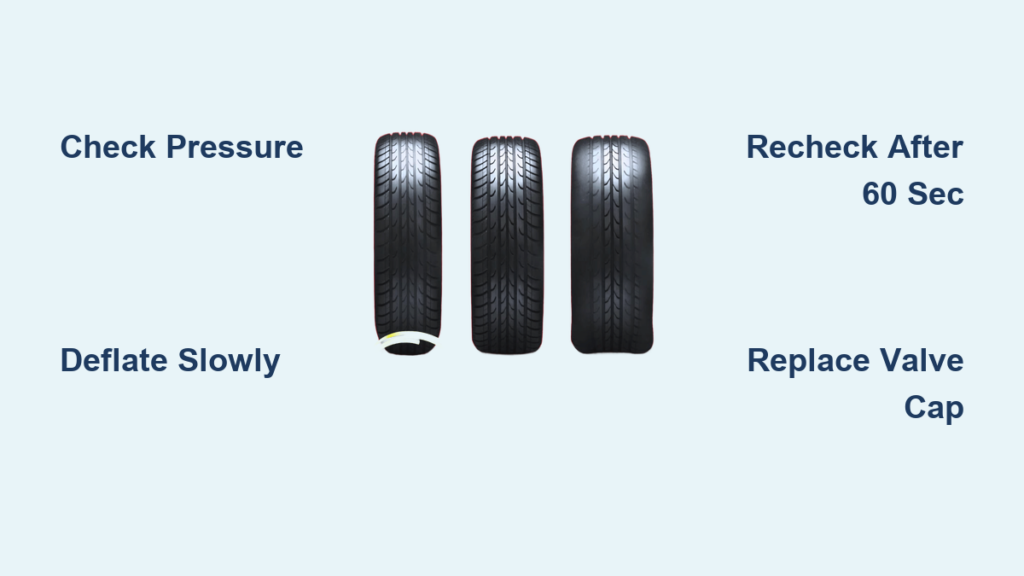
Press your valve stem cap firmly onto the valve stem’s center pin. You’ll hear a distinct hiss as air escapes. Hold for exactly 2 seconds, then immediately check pressure. If still over-inflated, repeat in 1-second bursts. For stubborn valves, insert a pen tip or straightened paperclip into the valve opening to hold the pin down. Pro tip: Deflate with the valve stem at 6 o’clock position (bottom of wheel) so air releases downward—this prevents moisture from entering the valve. Stop deflating when pressure reaches 2 PSI above your target (e.g., 34 PSI for a 32 PSI spec), as pressure drops slightly after valve removal.
Verifying Correct Pressure and Re-Sealing
Screw the valve cap back on tightly—this maintains pressure and keeps out moisture. Wait 60 seconds for pressure to stabilize, then recheck with your gauge. If you overshot, add air in 2-second bursts until hitting the exact recommended PSI. Never drive with caps off—they’re critical for maintaining seal integrity. Test by spraying soapy water on the valve; bubbles indicate a leak requiring cap replacement. Finally, inspect the tire for bulges or uneven tread that might indicate internal damage from prior over-inflation.
Finding Your Vehicle’s Exact Tire Pressure

The number on your tire’s sidewall (e.g., “MAX PRESS 51 PSI”) is not your target—it’s the maximum safe pressure for emergency loads. Your actual spec is always on the driver’s side door jamb sticker or in the glove compartment manual. For example:
| Vehicle Type | Typical Cold Pressure Range | Critical Exceptions |
|---|---|---|
| Sedans/SUVs | 30-35 PSI | +4 PSI when carrying full load |
| Performance Cars | 32-38 PSI | +2 PSI for track use only |
| Trucks | 35-45 PSI | +8 PSI for max payload |
Check pressures when tires are “cold” (parked 3+ hours). Driving heats tires, increasing pressure 4-6 PSI—never adjust based on “hot” readings. If your door jamb sticker is missing, consult your owner’s manual under “Tire Maintenance.” Never assume all four tires need identical pressure; many AWD vehicles specify different front/rear pressures.
Fixing Accidental Under-Inflation Mistakes

If you release too much air (below recommended PSI by 3+), immediate correction prevents damage. Add air in 2-second bursts, rechecking after each addition. Under-inflated tires generate dangerous heat at highway speeds—their flexing sidewalls can separate from the wheel rim. Critical warning: If pressure falls below 25 PSI on a standard passenger tire, drive slowly (<35 mph) to the nearest air pump. Every mile driven under-inflated causes irreversible internal damage. Never “top off” tires daily—consistent under-inflation indicates a slow leak needing professional repair.
Preventing Future Over-Inflation Disasters
Avoid repeat incidents with these field-tested techniques. Always inflate tires in 5 PSI increments, checking after each burst—gas station compressors often over-pressurize in 10-second intervals. Keep a $5 digital pressure gauge in your center console; dial gauges at gas stations frequently read 3-5 PSI high. During seasonal changes, check pressures monthly as temperature swings alter pressure 1 PSI per 10°F change. Finally, set phone reminders for “Tire Check Tuesdays”—most drivers only notice problems when tires are 15+ PSI off spec.
Final Note: Properly inflated tires improve fuel economy by up to 3% and extend tread life by 2,000+ miles. After fixing over-inflation, monitor pressure weekly for the first month—fluctuations indicate valve issues. If your tire consistently over-inflates despite correct filling, have a professional inspect for faulty TPMS sensors or valve core leaks. For immediate next steps, download your vehicle manufacturer’s tire maintenance PDF (search “[Your Make/Model] tire care guide”) and store it in your phone’s notes. Remember: that 32 PSI number isn’t arbitrary—it’s engineered for your safety, comfort, and tire longevity. Drive confidently knowing you’ve restored the precise balance between road contact and rolling resistance.