
That mysterious string of letters and numbers on your tire’s sidewall holds critical safety information you need to know. Learning how to decode DOT tire numbers reveals exactly when your tires were manufactured, where they came from, and whether they’ve reached their safe service life. This knowledge protects you from driving on dangerously aged rubber that could fail without warning, even if the tread looks perfectly fine.
Most drivers never notice the Department of Transportation (DOT) serial number embedded in their tire sidewalls, yet this code determines whether your tires are safe for the road. With tire-related accidents causing thousands of injuries annually, understanding how to decode DOT tire numbers puts you in control of one of your vehicle’s most critical safety components. In the next few minutes, you’ll learn to read these codes like a professional mechanic and make informed decisions about tire replacement.
Locate Your DOT Serial Number on Any Tire
Finding the DOT number requires knowing exactly where to look on your tire’s sidewall. This 10-12 character code always begins with “DOT” followed by additional letters and numbers, and appears on at least one sidewall—typically the outer side facing away from your vehicle.
Run your fingers along the tire’s sidewall between the size markings and the wheel rim to feel for the raised characters. Modern passenger tires display the full DOT code on the outboard sidewall, while some manufacturers place abbreviated versions on the inner sidewall. If you’re struggling to find it, clean the tire with soapy water and use a flashlight at a low angle to highlight the embossed characters.
Don’t confuse the DOT number with other sidewall markings like your tire size (P225/60R16), load index (97), or speed rating (H). The DOT code specifically begins with those four letters and contains no spaces or punctuation between characters. Older tires may have 10-character codes while modern tires use 11 or 12 characters for more detailed manufacturing information.
What to Do When the DOT Number Is Worn Off
If your tire’s DOT number has worn smooth from age or damage, replacement is immediately necessary. Tires without readable DOT markings cannot be verified for age or authenticity, making them potential safety hazards. Never attempt to guess a tire’s age based on appearance alone—rubber compounds degrade internally regardless of external condition. Document the missing DOT code with photos before installing replacement tires, as this may support warranty claims if premature wear caused the issue.
Break Down the 12-Character DOT Code Structure
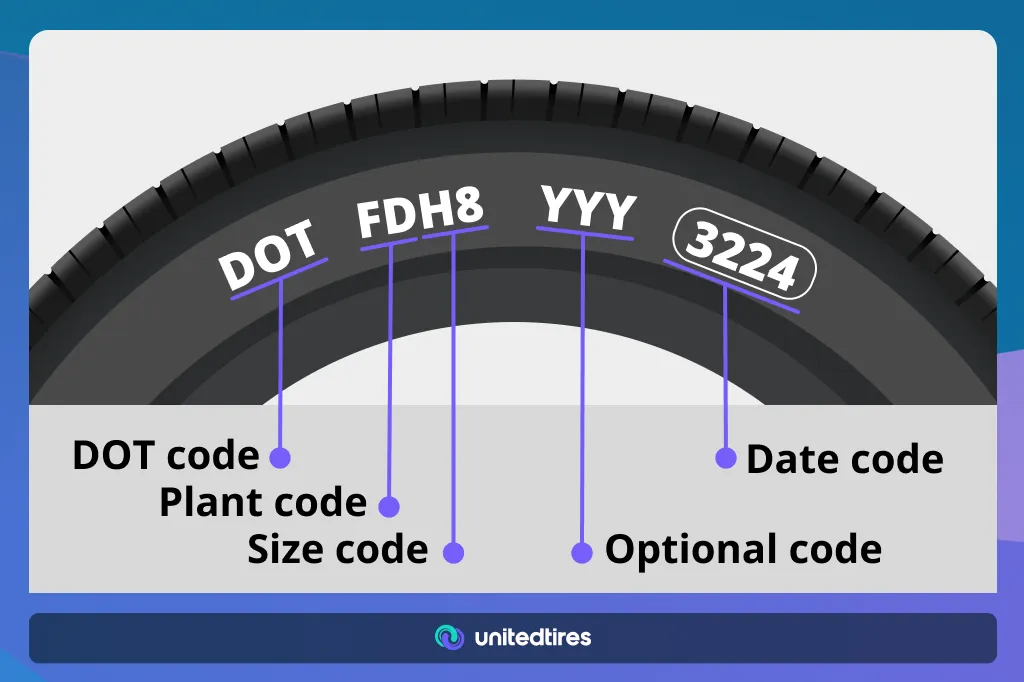
Modern DOT tire numbers follow a precise 12-character format where each segment reveals specific manufacturing details. Understanding how to decode DOT tire numbers starts with recognizing this standardized structure: positions 1-2 identify the manufacturer, 3-8 specify the plant, 9-10 indicate tire type, and 11-12 show the production date.
The manufacturer code (first two characters) uses unique combinations assigned by the National Highway Traffic Safety Administration (NHTSA). For example, “1P” identifies Michelin tires while “BA” represents Bridgestone products. These codes help track recalls and verify authenticity when purchasing used tires. Counterfeit tires often display incorrect or missing manufacturer codes, so always verify this segment matches the expected brand.
How Plant Codes Affect Tire Safety and Recalls
Characters three through eight form the plant code, which pinpoints the exact manufacturing facility and production line. When safety recalls occur, manufacturers use these characters to identify affected batches. A tire marked “PH AJ3R” after the manufacturer code indicates production at Michelin’s plant in Piqua, Ohio, while “8W G7L1” corresponds to Continental’s facility in Sumter, South Carolina. During recall investigations, this specificity allows safety officials to target only the tires from problematic production runs rather than issuing blanket recalls.
Read Manufacturing Dates from Week and Year Codes
The final two characters in modern DOT codes (positions 11-12) provide the most critical safety information: the week and year of manufacture. Character eleven indicates production week (01-52), while twelve shows the year. A tire ending in “1523” was made during the 15th week of 2023 (mid-April), while “4321” means week 43 of 2021 (late October).
Why Tire Age Matters More Than Tread Depth
Many drivers mistakenly believe tires only need replacement when tread wears down, but rubber compounds degrade over time regardless of use. The Tire Industry Association recommends replacing tires after six years, even with adequate tread remaining. A tire manufactured in 2017 (ending in “XX17”) should be replaced immediately in 2023, regardless of how new it looks. By learning how to decode DOT tire numbers, you avoid the dangerous misconception that “looks new” means “is safe.”
Identify Manufacturer and Plant Information Quickly

The first eight characters of the DOT code create a manufacturing fingerprint that helps verify tire authenticity and track safety records. When purchasing used tires, cross-reference the manufacturer code with official brand listings—Michelin uses “1P” and “M8,” Goodyear employs “GY” and “DY,” while Bridgestone applies “BA” and “BI.”
Spot Counterfeit Tires Using DOT Codes
Fake tires often display incorrect manufacturer codes or inconsistent plant information. Verify suspicious tires by checking the NHTSA’s online database of registered manufacturer codes. Legitimate tires will have consistent plant codes matching known production facilities—anything unusual (like European brands showing Asian plant codes) indicates potential counterfeits. When in doubt, contact the manufacturer directly with the full DOT code for verification before installation.
Understand Tire Specifications in Characters 9-10
Characters nine and ten of the DOT code contain tire type and size specifications specific to the manufacturer’s internal classification system. While these characters don’t directly correspond to the visible tire size (like P215/55R17), they indicate construction method and load range.
The ninth character typically identifies ply construction—radial tires (most common) use specific codes different from bias-ply tires. Some manufacturers also embed speed rating information here, though this varies by brand. The tenth character usually relates to load range, distinguishing standard-load (SL) from extra-load (XL) tires which require different inflation pressures.
Apply DOT Decoding to Real Tire Purchases
When shopping for tires, use your DOT decoding skills to avoid aged inventory. Dealers sometimes sell tires manufactured years before purchase date, putting you at risk from the moment you drive off the lot. A tire ending in “0519” was made in February 2019—already four years old when purchased in 2023, dangerously close to the six-year replacement threshold.
What to Do With New Tires Showing Old Dates
If a “new” tire shows a manufacturing date older than six months, negotiate a discount or request fresher stock. Reputable dealers maintain inventory turnover that keeps tires no older than 12-18 months when sold. Document the DOT code with photos before installation, as some manufacturers offer partial warranties based on manufacturing date rather than purchase date.
Recognize Safety Standards in DOT Certification
The DOT marking itself certifies compliance with Federal Motor Vehicle Safety Standard 139, which mandates rigorous testing for endurance, high-speed performance, and low-pressure operation. Tires without legitimate DOT markings haven’t undergone these safety tests and shouldn’t be driven on public roads.
How to Verify Genuine DOT Certification
Authentic DOT codes appear as continuous embossed characters without spaces or separators. Counterfeit tires often show stamped or painted markings, inconsistent character heights, or impossible manufacturer codes. Cross-reference the entire code with the manufacturer’s online verification system when possible—most major brands offer this service for consumer protection.
Determine Replacement Timing Using DOT Age and Condition
Combine DOT date information with physical inspection to determine optimal replacement timing. Tires manufactured before 2017 (ending in “XX17” or earlier) require immediate replacement regardless of tread depth. For tires between three and six years old, check for sidewall cracks, tread separation, or irregular wear patterns that indicate accelerated aging.
The Penny Test Plus DOT Verification Formula
Use this safety formula for comprehensive tire assessment: (DOT age in years) + (tread depth in 32nds) > 8. For example, a four-year-old tire (4) with 3/32″ remaining tread (3) equals 7—still acceptable. But a five-year-old tire (5) with 2/32″ tread (2) equals 7, approaching the critical threshold. When the sum reaches 8 or higher, replacement is urgent regardless of appearance.
Knowing how to decode DOT tire numbers transforms you from a passive vehicle owner into an active safety advocate for yourself and your passengers. This simple skill protects you from hidden dangers in aged rubber that could fail catastrophically on the highway. The next time you check your tires, take 30 seconds to locate and read that DOT code—it might reveal your tires are far older than you realized, or confirm they’re safely within their service life. By making DOT verification part of your regular tire maintenance routine, you ensure every journey starts with properly aged, manufacturer-certified safety under your wheels. Don’t wait for a blowout to learn this critical information—decode your DOT numbers today and drive with confidence knowing your tires meet both age and safety standards.