That persistent tire pressure warning light glowing on your Toyota Camry dashboard isn’t just an annoyance—it’s your vehicle’s way of telling you something’s wrong with your tire inflation. Whether your Camry recently had a tire rotation, experienced overnight temperature changes, or you simply noticed the flat-tire-shaped icon illuminating during your commute, knowing how to properly reset this system saves you unnecessary trips to the dealership. This guide delivers the exact steps to clear the tire pressure light on your Toyota Camry, covering every model year and addressing those frustrating situations where the light refuses to turn off.
The tire pressure monitoring system (TPMS) activates when tire pressure drops approximately 25% below manufacturer specifications. This warning light—shaped like a flat tire with an exclamation point—is crucial for maintaining optimal tire performance, preventing uneven wear, improving fuel economy, and avoiding potential safety hazards. Understanding why this light illuminates and how to properly reset it ensures you maintain your Camry’s performance while keeping unnecessary service expenses at bay.
Locate Your Camry’s TPMS Reset Button
Finding the TPMS reset button varies slightly depending on your Camry’s model year, but most vehicles position this essential component in one of three accessible locations. For the majority of Camry models from 2007 through current production, the reset button sits beneath the steering column on the left side, tucked near the steering wheel assembly where it’s easily reachable from the driver’s seat. This placement became standard starting with the 2007 model year and remains consistent through most generations.
Check Alternative Button Locations
Some Camry variants, particularly higher trims with leather interiors or specific model years, position the reset button inside the glove box on the left interior wall. If you don’t find it beneath the steering column, thoroughly check your glove compartment. A third location appears in center console models where the button resides in the storage compartment between the front seats. Once located, the button typically feels like a small rubberized switch that depresses with a satisfying click. Familiarizing yourself with this button’s location before you’re dealing with an illuminated warning light saves valuable time during actual reset attempts.
Execute the Standard Reset Procedure

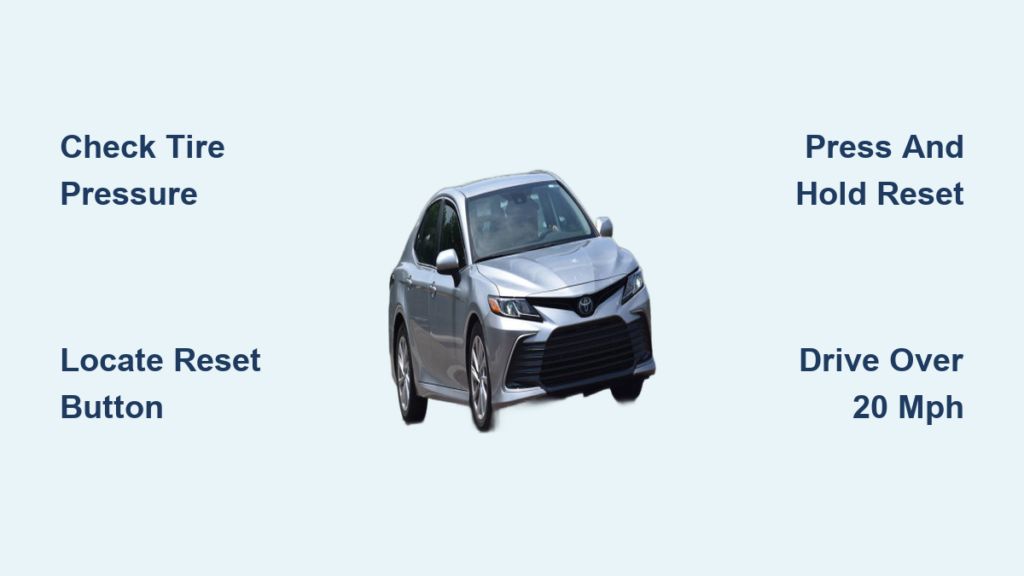
The most reliable method to clear the tire pressure light on most Toyota Camry models requires no special tools and takes less than five minutes. Before attempting any reset, confirm all tires are properly inflated to the specifications found on your driver’s side door jamb—typically 35 PSI for both front and rear tires when cold. Once verified, follow these precise steps:
- Turn your ignition to the “ON” position without starting the engine (push the start button twice without pressing the brake pedal for keyless models)
- Locate the TPMS reset button beneath the steering column or in its alternative location
- Press and hold this button until your tire pressure warning light blinks three times
- Release the button, turn the ignition off, wait 10 seconds, then start your engine
- The warning light should now be extinguished, confirming successful reset
Pro Tip: If your light remains illuminated after this procedure, drive at speeds above 20 mph for approximately ten minutes to allow the system to fully relearn sensor positions before attempting another reset.
Reset Using the Driver Information Display (2012+ Models)
Toyota Camry models from 2012 onward feature a multi-information display that provides menu-based access to vehicle settings including TPMS calibration. This method offers a more intuitive interface for tech-savvy owners:
- Ensure all tires are correctly inflated first
- Turn the ignition to “ON” without starting the engine
- Use steering wheel-mounted controls to navigate to “Vehicle Settings” or “Settings”
- Within this menu, locate and select “TPMS” or “Tire Pressure” options
- Choose “Set” or “Reset” to initiate the relearn process
- Follow any on-screen prompts to confirm the operation
After completing this process, drive at speeds above 15-20 mph for approximately ten minutes to allow the system to detect consistent pressure readings from all four tires. During this driving period, avoid harsh acceleration or braking for optimal system calibration.
Troubleshoot Persistent Warning Light Issues

When the tire pressure light refuses to reset despite following all procedures correctly, systematic troubleshooting becomes essential. Begin by confirming no genuine pressure issues exist—use a second gauge to verify your readings as inexpensive gauges often provide inaccurate measurements. Check all four tires plus the spare, as one under-inflated tire will override any reset attempt.
Identify Common Reset Blockers
Several factors can prevent successful reset even with proper tire inflation:
- Damaged valve stems: Cracked or damaged valve stems cause slow leaks that gradually reduce pressure
- Sensor battery failure: TPMS sensor batteries typically last 5-10 years before failing
- Blown TPMS fuse: Consult your owner’s manual for fuse box locations and replace with identical amperage
- Physical sensor damage: Sensors can crack during tire mounting if improper tools are used
If pressure holds steady after several days of monitoring but the light remains illuminated, the issue likely involves the TPMS system itself rather than actual pressure problems. Signs of sensor failure include the warning light illuminating intermittently or cycling on and off during a single drive.
Model-Specific Reset Procedures by Year
2007-2011 Camry Reset Protocol
These earlier-generation Camrys feature a dedicated TPMS reset button beneath the steering column. The reset procedure requires the vehicle to be stationary with the ignition in the “ON” position. Press and hold the reset button until the warning light blinks three times. Unlike newer models, these generations don’t require post-reset driving—the system typically resets immediately upon button release.
2012-2017 Camry Dual-Method Reset
This generation offers dual reset options: the physical button beneath the steering column or menu navigation through steering wheel controls. After performing the reset, drive at speeds above 20 mph for about ten minutes to help the system relearn sensor positions, particularly important if you’ve recently rotated or replaced tires.
2018-2024 Camry Touchscreen Reset
Newer Camrys integrate TPMS reset access through the central touchscreen display rather than a physical button. Navigate to Vehicle Settings, find TPMS options, and select the reset function. Some models use a simplified button procedure: with the vehicle on, hold the TPMS button for three to five seconds until the light flashes. The system automatically relearns sensor positions during normal driving, requiring no additional driving procedure.
Perform Proper Reset After Tire Service
Tire rotations, replacements, and wheel service disrupt your TPMS system’s memory of which sensor corresponds to which wheel position. Performing a relearn procedure after any tire service ensures your dashboard correctly identifies which specific tire has a pressure issue.
After Tire Rotation
Without relearning, your Camry might alert you about a pressure issue in the “right front” tire when the actual problem exists in the left rear. After rotation, inflate all tires to correct pressure, then perform the standard reset procedure. Drive for ten minutes at speeds above 20 mph to allow the system to associate each sensor with its new position.
After Tire Replacement
New replacement tires require the same position relearning as rotations, but replacement introduces additional complexity if you’ve installed new TPMS sensors. Replacement sensors require programming to communicate with your vehicle’s receiver—a process requiring specialized tools typically available at tire shops. After installing new sensors or tires, perform the standard reset procedure and complete the driving relearn period.
When Professional Help Becomes Necessary
Seek professional assistance when the tire pressure warning light flashes rapidly instead of remaining steadily illuminated, as this indicates a system malfunction rather than a pressure issue. Professional help is also warranted if the warning light comes on immediately upon starting your vehicle before driving, or if your driver information display shows pressure readings that conflict with your gauge readings.
A Toyota dealership or qualified mechanic can perform comprehensive TPMS diagnostics, identifying sensor faults, signal interference, or system malfunctions that DIY methods cannot detect. This service typically costs $50 to $100 but provides definitive answers and proper repairs. For complex electrical issues or sensor programming requirements, professional equipment is essential—attempting these repairs without proper tools often causes additional problems.
Maintain Your TPMS for Long-Term Reliability
Check tire pressure monthly, including the spare tire if equipped with a TPMS sensor. Temperature changes of 10°F alter pressure by approximately 1-2 PSI, meaning seasonal transitions often trigger warning lights. When adding air, fill to the door jamb specification rather than maximum sidewall pressure—over-inflated tires reduce traction and cause uneven wear.
Protect TPMS sensors during tire service by choosing reputable tire shops with TPMS experience. Avoid tire sealants near valve stems, as these products can clog sensor openings. Replace TPMS sensor batteries when you notice intermittent operation—signs of a failing sensor battery include the light cycling on and off or pressure readings fluctuating between drives.
By understanding how your Toyota Camry’s TPMS works, knowing the correct reset procedures for your model year, and maintaining proper tire inflation, you can keep that warning light off while ensuring your tires deliver optimal performance, safety, and longevity. Master these reset techniques and you’ll never need to visit the dealership just to clear a simple tire pressure warning light again.