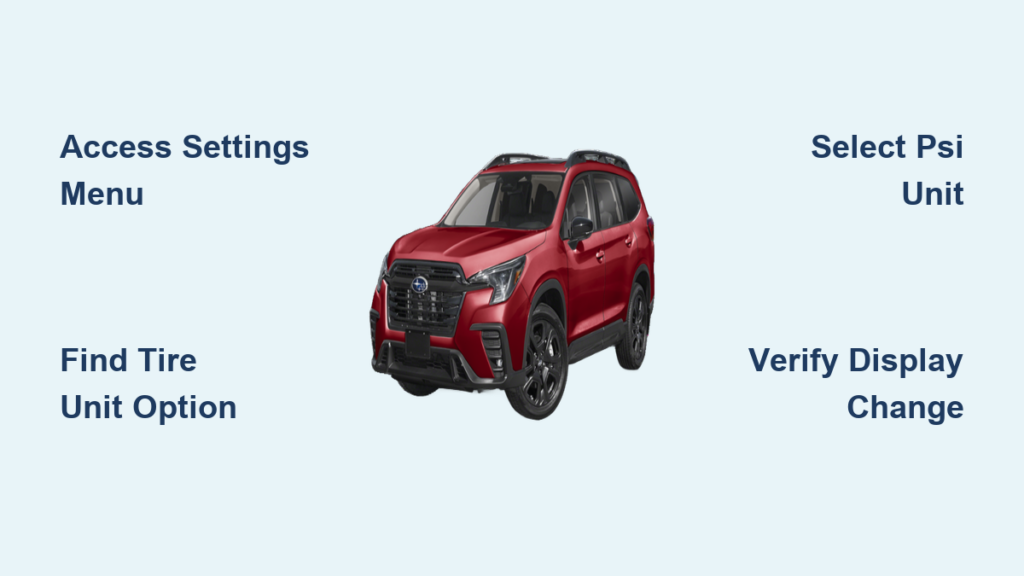
You’ve just climbed into your Subaru Ascent, noticed the tire pressure readings on your dashboard, and realized they’re displaying in kilopascals (kPa) instead of the familiar pounds per square inch (PSI) you’re used to. If you find yourself constantly doing mental math to convert those numbers into something meaningful, you’re not alone—most North American drivers prefer PSI since it’s the standard measurement used at gas stations and tire shops. The good news is that changing your Subaru Ascent’s tire pressure display units takes less than two minutes once you know exactly where to navigate in the vehicle’s menu system. This guide walks you through the complete process for switching from kPa to PSI, explains why your settings might mysteriously revert, and provides troubleshooting steps when the change doesn’t stick.
Before you begin, note that while this procedure works for most Subaru Ascent models from 2019 through current production, menu structures vary slightly between trim levels. The 2019 Ascent and 2020 Touring have been specifically documented with this process, but your specific vehicle may have minor navigation differences. Always refer to your owner’s manual for model-year specific instructions, particularly if you encounter unexpected menu options during the procedure.
Access Your Subaru Ascent’s Vehicle Settings Menu
The tire pressure unit setting lives within your Ascent’s dashboard menu system, controlled entirely through your steering wheel navigation buttons. These controls serve as your gateway to vehicle customization, but many owners struggle with them initially due to inconsistent feedback.
Start with your vehicle powered on but parked—either in accessory mode or with the engine running. Locate the steering wheel controls: typically four directional buttons (up, down, left, right) plus a center “OK” button. Press the right button repeatedly until you reach the main Settings menu displayed between your gauge cluster. If your model has different controls, look for buttons marked with menu icons or labeled “Menu,” “Info,” or “OK.”
Take a moment to practice basic navigation before hunting for the tire pressure setting. Use the up/down buttons to scroll through menu options and the center button to select items. The left button typically functions as “back” to return to previous menus. Many owners accidentally skip past the correct option because they navigate too quickly, so move deliberately through each menu level. If you accidentally select the wrong option, simply use the left or back button to return to the previous screen without making changes.
Locate the Exact Tire Pressure Display Unit Setting

With the main Settings menu open, navigate to “Vehicle Settings” using your steering wheel controls. This section houses all your vehicle monitoring configurations, including tire pressure preferences. Scroll carefully through this menu—many Ascent owners mistakenly select “TPMS Settings” or “Tire Pressure Warning” instead of the actual display unit option.
Look specifically for an option labeled “Tire Pressure Display Unit” or “Tire Pressure Unit.” The 2019 Subaru Ascent Owner’s Manual references this exact setting on pages 196-197, confirming its location within the vehicle settings hierarchy. If you don’t see this precise wording, search for variations containing “tire pressure” and “unit” or “display.”
When you find the correct setting, you’ll see two options: kPa (kilopascals) and PSI (pounds per square inch). The default setting typically displays kPa, which shows pressure readings in the 200-350 range, while PSI uses the more familiar 30-35 range for standard tire pressure. Selecting this option confirms you’ve found the right setting—other similar-sounding options won’t show these specific measurement choices.
Switch from kPa to PSI in Three Clicks
Once you’ve selected “Tire Pressure Display Unit,” use your steering wheel controls to highlight “PSI” from the available options. You’ll typically see immediate visual confirmation—a checkmark, highlighted text, or the option remaining selected after navigation. Some Ascent models require pressing the center “OK” button to confirm your selection, while others auto-save when you navigate away.
After selecting PSI, press the left or back button repeatedly until you return to the main dashboard display. Most Subaru Ascent models automatically save your setting during this navigation process—there’s no separate “save” button to press. However, certain trim levels may display a brief “Settings Saved” confirmation message at the bottom of the screen. If you don’t see this message, don’t worry; the system typically registers your change as you exit the menu structure.
Important note: Some early 2019 models require a complete vehicle restart for the change to take effect. If you don’t see PSI immediately after exiting the menu, turn your vehicle completely off, wait 15 seconds, then restart the engine before verifying your change.
Verify Your Subaru Ascent Now Displays PSI Correctly
Never assume the setting changed successfully—always verify before relying on the display. After exiting the settings menu, check your main dashboard for tire pressure readings. If you previously saw numbers like “220 kPa” or “240 kPa,” you should now see values around “32 PSI” or “34 PSI” depending on your actual tire pressure.
For thorough verification, check multiple display areas if your Ascent has additional tire pressure information screens. Some models show pressure readings in the infotainment system’s vehicle settings section, while others display them only in the instrument cluster. Confirm that all locations consistently show PSI rather than kPa—occasional glitches affect only certain display areas while leaving others unchanged.
If your readings still appear in kPa after verification:
– Repeat the selection process, ensuring you’re choosing “Tire Pressure Display Unit” specifically
– Perform a complete vehicle restart (power off for 30 seconds)
– Check if your steering wheel buttons are responding properly
Why Your Subaru Ascent Resets Tire Pressure Units After Battery Disconnect

Here’s the critical detail that frustrates many Subaru Ascent owners: any battery disconnect—whether for jump-starting, routine maintenance, or replacement—will reset all your vehicle’s custom settings to factory defaults. This means your carefully configured PSI preference will instantly revert to kPa, along with door unlock behavior, alarm volume, and clock settings.
This reset occurs because the Ascent’s settings are stored in volatile memory that requires constant power to maintain. During dealership service visits, mechanics routinely disconnect the battery for electrical work or safety reasons, triggering this reset without warning. Many owners return from service appointments confused by suddenly unfamiliar settings.
To prevent this recurring frustration:
– Keep a photo on your phone of all custom settings pages
– Before service appointments, note your preferred configurations
– Specifically request that the service department avoid battery disconnection
– After any service visit, immediately verify your tire pressure display unit
Troubleshoot When Tire Pressure Unit Change Fails
When your Subaru Ascent refuses to switch from kPa to PSI despite following the correct procedure, try these proven solutions before visiting the dealership:
Perform a complete system reset
Turn the vehicle completely off, open the driver’s door (to ensure full system shutdown), wait 60 seconds, then restart. Some Ascent models require this extended power cycle for settings to fully propagate.
Check for button responsiveness issues
Clean your steering wheel navigation buttons with a slightly damp microfiber cloth. Sticky buttons often cause missed inputs that make it seem like your selection didn’t register. Test all directional buttons to ensure consistent responsiveness.
Verify you’re using the correct menu path
Some 2020+ Touring models require accessing settings through the infotainment screen first. If standard steering wheel navigation fails, try:
1. Press the “Menu” button on the infotainment system
2. Navigate to “Vehicle” settings
3. Look for “Tire Pressure Display Unit” in this alternative menu path
Confirm your vehicle’s software version
Early production Ascent models had software limitations affecting settings persistence. Check for available software updates at your Subaru dealership—many settings issues resolve with the latest firmware.
Maintain Your Preferred Tire Pressure Display Long-Term
Now that you’ve successfully configured your Subaru Ascent to display tire pressure in PSI, implement these habits to maintain your preference:
Create a “settings cheat sheet” in your glove compartment listing all custom configurations. Include:
– Tire pressure display unit: PSI
– Door unlock behavior: All doors
– Alarm volume: Medium
– Any other personalized preferences
Before service appointments, photograph your current settings screens. Modern smartphones make this effortless—simply snap pictures of each relevant settings page for quick reference after service.
Develop the habit of checking your tire pressure display immediately after any battery-related event. This takes just three seconds but prevents weeks of confusion from unexpected unit changes.
Most importantly, understand that this process represents one of the simplest customizations available in your Subaru Ascent. Once you’ve successfully changed your tire pressure units to PSI, you’ll wonder why you ever struggled with kPa readings. The time investment pays immediate dividends in dashboard clarity and eliminates those frustrating mental conversions every time you check your tire pressure.
Final Note: Your properly configured Subaru Ascent should now display tire pressure in the familiar PSI measurement you prefer. Remember that battery disconnections remain the primary cause of unexpected resets, so maintain your settings documentation and verify your display after any service visit. With just a few minutes of initial setup and these simple maintenance habits, you’ll enjoy consistent, understandable tire pressure readings throughout your ownership experience.