Nothing disrupts your day like the unmistakable thump-thump-thump of a flat tire. Whether you’re stranded on a busy highway shoulder or dealing with a slow leak in your driveway, knowing how to change a car tire is one of the most valuable skills every driver should possess. This practical knowledge transforms a potentially dangerous situation into a manageable task that most people can complete in 15 to 30 minutes with basic tools. Mastering this essential procedure not only saves you money on roadside assistance but also gives you the confidence to handle emergencies safely and efficiently—because when you need this skill, there’s never a convenient time.
Before you ever face a flat tire situation, take time to familiarize yourself with your vehicle’s emergency equipment. Every passenger car comes with a spare tire, jack, and lug wrench, though they’re often tucked away in the trunk or beneath the cargo floor. This guide provides the complete step-by-step process for changing a tire safely, including often-overlooked details that prevent dangerous mistakes. By the end, you’ll know exactly how to change car tire emergencies from start to finish, whether you’re a new driver or someone who’s never attempted this critical automotive task.
Gather Essential Tools and Equipment Before You Need Them
Your vehicle’s emergency kit contains everything required for a tire change, but finding these items during an actual emergency proves much harder than when you’re parked safely at home. Locate your spare tire (typically in the trunk well), jack (often stored with the spare), and lug wrench (usually with the jack). Check your spare’s air pressure monthly—most compact “donut” spares require 60 PSI, which is significantly higher than regular tires. Many drivers discover too late that their spare has been slowly leaking air for months.
Consider adding these helpful extras to your emergency kit:
– Work gloves to protect hands from sharp wheel edges
– Reflective safety vest for roadside visibility
– Flashlight with fresh batteries for nighttime emergencies
– Small piece of cardboard or kneeling pad for comfort
– Wheel chocks (or a brick) to prevent rolling
Don’t wait for a flat tire to test your equipment. Practice removing your spare and operating the jack in your driveway. This simple preparation reveals whether your lug wrench fits properly, if the jack mechanism works smoothly, and if you can safely position the jack. Many drivers discover their spare tire is improperly inflated or their jack is rusted shut only when they desperately need them.
Find a Safe Location Before Attempting Any Work
When you notice a flat tire while driving, your first priority is getting to a safe location. Gradually reduce speed while maintaining control of the vehicle—sudden braking or steering can cause loss of control with a compromised tire. Look for wide shoulders, parking lots, or service stations where you can pull completely off the roadway. Avoid soft ground, slopes, or areas near sharp curves where passing traffic poses greater risk.
Once stopped, activate your hazard lights immediately and set up reflective triangles or road flares if available. Position these 50-100 feet behind your vehicle to alert approaching traffic. Keep all passengers away from the vehicle, ideally behind a guardrail or barrier. Never attempt a tire change on the side of a highway—call roadside assistance instead. If you must change a tire on a slight incline, always position wheel chocks against the tires opposite the flat to prevent rolling.
Secure Your Vehicle Before Loosening Lug Nuts

Applying the parking brake and shifting into park (automatic) or first gear (manual) prevents your vehicle from rolling during the tire change. For added security, place wheel chocks against the tires diagonally opposite the flat tire—front tire chocked if changing a rear tire, and vice versa. This double protection ensures your vehicle remains stationary while jacked.
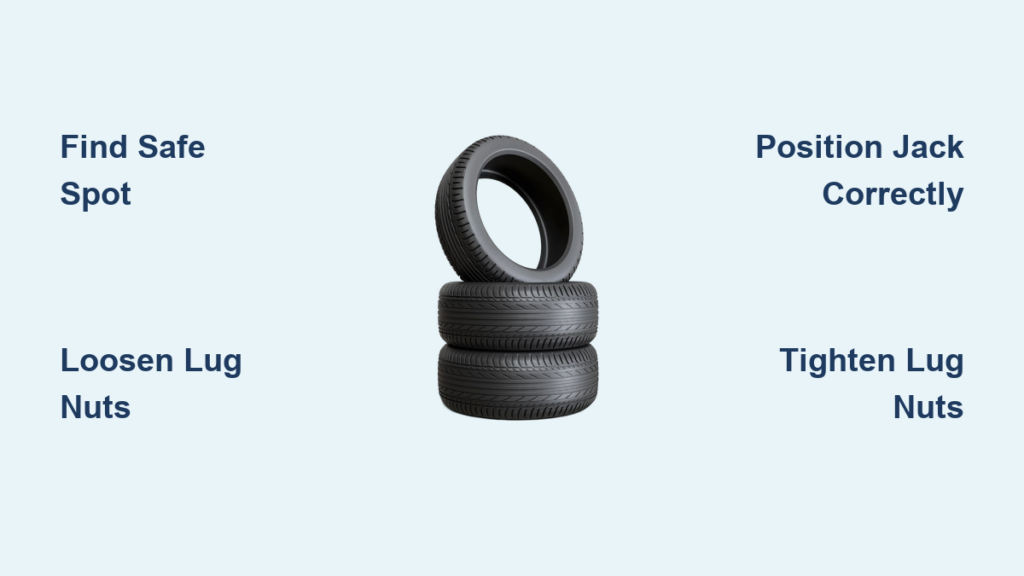
Loosen lug nuts while the tire remains on the ground—this prevents the wheel from spinning as you break the nuts free. Use the star pattern technique: loosen one nut slightly, then move to the nut directly across the wheel, continuing until all are partially loosened. Most lug nuts require counterclockwise rotation to loosen, but some vehicles have left-handed threads on the driver’s side. Apply steady downward pressure with your full body weight rather than kicking or jumping on the wrench.
Position Jack Correctly and Lift Vehicle Safely

Consult your owner’s manual for exact jack points—these reinforced sections of the vehicle frame prevent damage during lifting. Never jack on plastic components, suspension parts, or the oil pan. Common jack points include notches behind front wheel wells and ahead of rear wheel wells. Position the jack base on firm, level ground before raising it.
Pump the jack handle slowly while watching for stability. Raise the vehicle until the flat tire clears the ground by 2-3 inches—enough space to remove the wheel but not so high that the jack becomes unstable. Stop immediately if you hear unusual noises or notice the jack tilting. Never place any body parts under a raised vehicle, even briefly—jack failures happen without warning.
Remove Flat Tire and Inspect Wheel Components
With the vehicle raised, finish removing all lug nuts and place them in your lug wrench socket or a secure container. Pull the wheel straight toward you while supporting its weight—it may stick slightly to the hub due to rust or corrosion. If stuck, gently kick the tire’s sidewall (not the rim) to break the seal.
Inspect the wheel hub for debris, rust, or damage before mounting the spare. Check brake components for obvious leaks or damage, though a thorough inspection requires professional service. Set the flat tire on its side away from traffic to prevent rolling. If the tire has a large puncture or sidewall damage, drive carefully to the nearest service station after installing the spare.
Mount Spare Tire Properly to Avoid Dangerous Failures
Align the spare’s mounting holes with the wheel studs, then push it straight onto the hub until it seats completely flush. Never force a wheel onto misaligned studs—that damages components and creates dangerous driving conditions. Hand-tighten all lug nuts in the star pattern to center the wheel before lowering the vehicle.
Verify your spare’s rotation direction—some have arrows indicating proper orientation. Compact spares (donuts) have strict limitations: typically 50 mph maximum speed and 50-70 miles maximum distance. These temporary tires lack the structural integrity of full-size tires and can overheat dangerously if driven too far or too fast.
Lower Vehicle and Tighten Lug Nuts to Proper Torque

Begin lowering the vehicle slowly until the spare makes light contact with the ground but the vehicle’s weight still rests partially on the jack. Now tighten lug nuts in the star pattern using your full body weight on the wrench. Avoid standing on the wrench—this often strips threads or rounds nut corners.
Once fully lowered, remove the jack and perform a final tightening pass. For optimal safety, use a torque wrench to verify lug nut tightness (typically 80-100 ft-lbs for most vehicles). Improperly tightened lug nuts cause wheels to wobble or, worse, detach while driving. Double-check all nuts before driving away.
Complete Critical Post-Change Safety Checks
Before driving, walk around your vehicle to verify the spare is properly mounted and appears level. Check that no tools remain beneath the vehicle. Drive slowly for the first few miles, testing brakes gently and listening for unusual noises. Stop immediately if you feel vibration, hear thumping, or notice handling issues.
Visit a tire shop as soon as possible to repair or replace your flat tire. Compact spares aren’t designed for long-term use and can fail unexpectedly. Remember that your vehicle’s handling, braking, and speed capabilities change with a temporary spare—adjust your driving accordingly until you’ve restored your full-size tire.
Pro Tip: Store a small tire pressure gauge in your emergency kit—many service stations don’t provide gauges, and underinflated spares cause more roadside emergencies than flat tires themselves. Critical Reminder: Never attempt to change a tire on a highway shoulder—call roadside assistance instead. Your life is worth more than 20 minutes of inconvenience. Keep your emergency kit updated, practice the procedure annually, and you’ll handle flat tire situations with confidence when they inevitably occur.