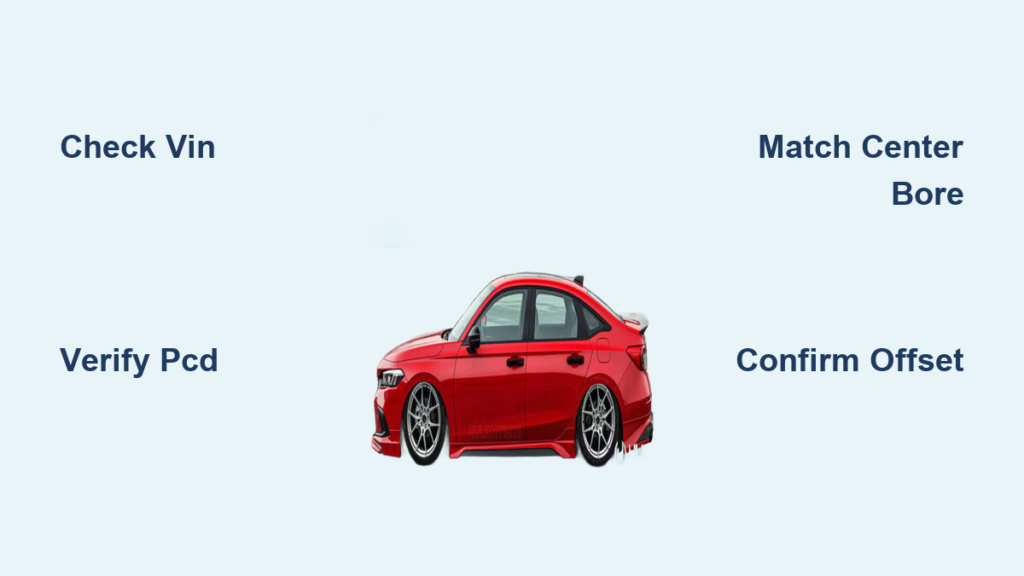
You’re standing in a tire shop, ready to upgrade your Honda Civic’s wheels, when the salesperson asks for your bolt pattern. If you’re staring blankly, you’re not alone—thousands of Civic owners make costly wheel purchase mistakes each year because they don’t know this critical specification. The Honda Civic tire bolt pattern determines whether wheels will physically mount to your vehicle’s hub, and getting it wrong means wasted money, installation headaches, and potential safety hazards. With Honda using four different bolt patterns across 12 generations spanning 50+ years, identifying your exact specification is non-negotiable for proper wheel fitment. This guide cuts through the confusion, delivering precise bolt pattern information for every Civic generation from 1972 through 2026, including engine-specific variations and critical fitment considerations you must verify before buying wheels.
Why Your Civic’s Bolt Pattern Matters for Safety and Performance
Installing wheels with an incompatible bolt pattern creates dangerous driving conditions—imagine lug nuts that seem tight but can’t properly center the wheel on the hub, causing vibrations at highway speeds or, worse, wheel detachment. The bolt pattern (technically called Pitch Circle Diameter or PCD) consists of two numbers: the first indicates how many lug holes/studs secure the wheel (4 or 5), while the second represents the diameter in millimeters of the imaginary circle passing through all lug hole centers. For Honda Civics, you’ll encounter four distinct patterns: 4×100, 4×114.3, 4×120, and 5×114.3.
Critical mistake to avoid: Never assume all Civics share the same bolt pattern. A 2004 Civic sedan (4×100) and 2006 Civic coupe (5×114.3) look nearly identical but require completely different wheels. Installing 4×100 wheels on a 5×114.3 hub won’t work, and attempting to force fit could damage your hub or create a dangerous situation. Always verify your specific generation’s pattern before purchasing wheels—this single step prevents 95% of wheel fitment problems Civic owners experience.
How to Locate Your Civic’s Bolt Pattern Without Measuring
You don’t need calipers or complex tools to identify your Honda Civic tire bolt pattern—here’s how to find it quickly:
- Check your owner’s manual – The specifications section lists your exact bolt pattern
- Examine the driver’s side door jamb sticker – Many Civics include wheel specifications here
- Look at existing wheels – The bolt pattern is often stamped on the back of the wheel
- Contact your dealer – Provide your VIN for precise bolt pattern confirmation
Pro tip: If you’re shopping online for wheels, reputable retailers require your year, make, model, and trim level to filter compatible options—don’t skip these fields! Entering “2015 Honda Civic” without specifying LX, EX, or Si could lead to recommending wheels for the wrong bolt pattern.
1972-1979 First-Gen Civics: Why Your 4×120 Pattern Is Unique Today
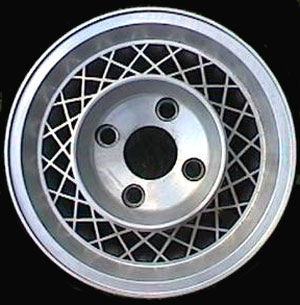
If you own a classic Honda Civic from 1972-1979 (SB1, SG, SE, or VB models), you’re working with the rarest Civic bolt pattern: 4×120. This configuration means your wheel selection is dramatically more limited than owners of newer Civics. Unlike later generations that share patterns with numerous vehicles, the 4×120 pattern was nearly exclusive to first-gen Civics, making true OEM-style replacement wheels challenging to find today.
What this means for you: When restoring or modifying your vintage Civic, expect to pay premium prices for reproduction wheels or invest in hub-centric adapters. Many classic car enthusiasts unknowingly purchase modern 4×100 wheels (common on 1980s-2000s Civics), only to discover they don’t fit. Before spending hundreds on wheels, verify they specifically state 4×120 compatibility—don’t trust vague “fits classic Honda” claims.
1983-2005 Civic Models: The 4×100 Bolt Pattern Era Explained

From the second generation (1979-1983) through the seventh generation (2000-2005), Honda standardized the 4×100 bolt pattern across most Civic trims, creating exceptional wheel interchangeability across 22 model years. This pattern—four lug holes arranged in a 100mm diameter circle—dominated Civic production until 2005, making it the most common vintage Civic bolt pattern today.
Critical Sixth-Generation Exception (1995-2000)
Here’s where things get tricky: While most sixth-generation Civics (EJ, EK, EM models) used 4×100, certain trims including the Civic HX and some international models featured a 4×114.3 pattern. If you own a 1995-2000 Civic, don’t assume it’s 4×100—verify by checking your VIN or measuring your hub. This rare variation catches many owners off guard when their newly purchased “Civic-compatible” wheels don’t fit.
Expert note: The 4×100 pattern remains popular in the aftermarket, with countless replica and performance wheels available. However, ensure any wheel you select has the correct center bore (56.1mm for most 4×100 Civics) and proper offset (+38 to +55mm typically) to prevent rubbing or handling issues.
2005-2026 Modern Civics: The 5×114.3 Standard You Can Rely On
Starting with the eighth generation in 2005, Honda standardized the 5×114.3 bolt pattern (also called 5×4.5 inches) across all Civic models—a decision that benefits owners immensely today. This change aligned Civics with numerous other vehicles including Acuras, Mazdas, Nissans, and many European brands, creating one of the largest aftermarket wheel selections available.
Why This Pattern Benefits You Today
The 5×114.3 pattern used on eighth through eleventh generation Civics (2005-present) offers three major advantages:
- Massive aftermarket selection: Over 80% of aftermarket wheels accommodate this pattern
- Cross-generation compatibility: Wheels fit from 2005 FD models through current 2024 XI models
- Cost savings: High demand keeps prices competitive compared to rarer patterns
Pro tip: When shopping for wheels for your 2005+ Civic, you can confidently purchase any 5×114.3 wheel—but don’t stop there. Verify center bore (64.1mm for most modern Civics), offset requirements (typically +50 to +55mm), and lug seat type (most Civics use conical 60-degree seats) for perfect fitment.
Civic Bolt Pattern Cheat Sheet: Find Your Generation Instantly
Don’t waste time scrolling—here’s the bolt pattern for your specific Civic generation at a glance:
- 1972-1979 (1st Gen): 4×120 (SB1, SG, SE, VB)
- 1979-2005 (2nd-7th Gen): 4×100 (except some 1995-2000 models: 4×114.3)
- 2005-2012 (8th Gen): 5×114.3 (FD, FA, FG platforms)
- 2011-2016 (9th Gen): 5×114.3 (FB, FG platforms)
- 2016-2022 (10th Gen): 5×114.3 (FC platform)
- 2022-2026 (11th Gen): 5×114.3 (XI platform)
Critical reminder: Engine size doesn’t affect bolt pattern on any Civic generation. A 1.3L hybrid Civic and 2.0L Si model from the same generation share identical bolt patterns. Don’t let salespeople convince you otherwise—this is a common upsell tactic.
Five Critical Measurements Beyond Bolt Pattern
Knowing your Honda Civic tire bolt pattern is essential but insufficient for proper wheel fitment. You must also verify these four specifications to avoid dangerous or damaging installations:
- Center bore diameter: Must match your hub (56.1mm for 4×100 Civics, 64.1mm for 5×114.3 models)
- Wheel offset: Affects handling and clearance (typically +38 to +55mm for Civics)
- Lug seat type: Conical (60°), ball seat, or flat seat—must match your lug nuts
- Lug nut thread size: M12x1.5 for most modern Civics (confirm for your generation)
Warning: Using wheels with incorrect center bore without hub-centric rings causes excessive vibration and accelerated wear on suspension components. Never rely solely on lug nuts to center your wheels—they’re designed to secure, not center.
How to Measure Your Civic’s Bolt Pattern Yourself

If documentation is unavailable, here’s how to accurately measure your Honda Civic tire bolt pattern:
For 4-Lug Patterns (1972-2005 models):
- Measure center-to-center between two adjacent lug holes
- Multiply that measurement by 1.414 to get your PCD
- Example: 70.7mm between holes × 1.414 = 100mm (4×100 pattern)
For 5-Lug Patterns (2005+ models):
- Measure from the inside edge of one hole to the outside edge of the hole directly across
- This measurement equals your PCD
- Example: 114.3mm measurement = 5×114.3 pattern
Expert tip: Use a digital caliper for precise measurements—ruler measurements often contain enough error to misidentify your pattern. When in doubt, visit a tire shop; most will measure your hub for free.
Avoid These 3 Costly Bolt Pattern Mistakes
Honda Civic owners lose thousands annually replacing incorrectly purchased wheels—don’t become a statistic:
- Assuming all “Civics” share the same pattern: 2004 and 2006 models require different wheels
- Trusting online marketplace listings: Sellers often list incorrect patterns—verify independently
- Ignoring center bore requirements: Bolt pattern matches but wheels won’t seat properly
Time-saving shortcut: Before purchasing wheels online, call the retailer and provide your exact Civic year, trim, and VIN. Reputable sellers will confirm compatibility rather than risk returns.
Final Note: Knowing your Honda Civic tire bolt pattern prevents dangerous installations, saves money on incompatible wheels, and expands your aftermarket options. For pre-2005 Civics, verify whether you have the standard 4×100 or the rare 4×114.3 pattern. All 2005 and newer Civics use 5×114.3 reliably across every trim and engine option. When purchasing wheels, always confirm center bore, offset, and lug specifications alongside bolt pattern for perfect fitment. Bookmark this guide—you’ll reference it every time you upgrade your Civic’s wheels.