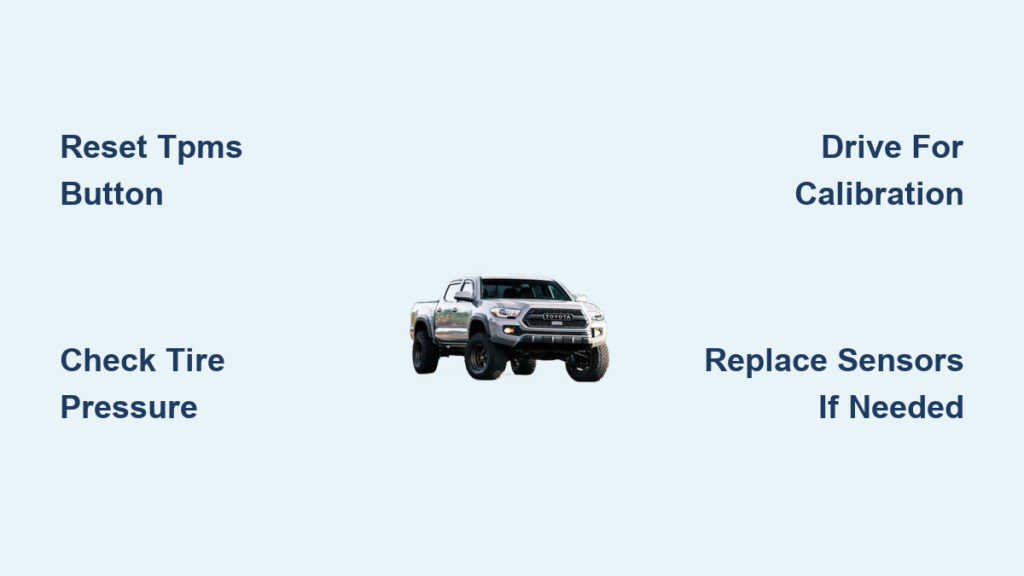
That persistent TPMS warning light on your Toyota Tacoma dashboard can be more than just an annoyance—it’s a critical safety indicator you shouldn’t ignore. Whether you’ve just rotated your tires, adjusted pressure for off-roading, or replaced a flat, knowing how to properly reset your Toyota Tacoma tire pressure monitoring system is essential for maintaining optimal vehicle performance and safety. This comprehensive guide delivers the exact reset procedures, troubleshooting techniques, and maintenance tips you need to eliminate that frustrating warning light and keep your Tacoma running smoothly.
Unlike generic reset instructions that don’t account for model year variations, this guide covers everything from basic button resets to diagnosing stubborn sensor failures. You’ll learn the precise steps that work across different Tacoma generations, discover why standard methods sometimes fail, and gain the confidence to handle most TPMS-related issues without visiting a dealership.
Locate Your Tacoma’s TPMS Reset Button Properly

Finding the TPMS reset button correctly is the first critical step in successfully recalibrating your system. On most Toyota Tacoma models, this button sits to the left of the steering column, tucked beneath the dashboard near the hood release mechanism. You’ll need to crouch down slightly to see and access it on the kick panel below the steering wheel.
The button is typically small and may feature the TPMS symbol (an exclamation point inside a U-shaped tire icon), though some models have an unlabeled plastic tab. Take time to identify it before attempting a reset—it requires firm, sustained pressure to activate the calibration sequence. Knowing its exact location prevents frustration when you’re mid-procedure.
Critical preparation step: Before pressing the button, confirm all tires (including the spare on 2007+) are inflated to Toyota’s recommended pressure—usually 32 psi for models like the 2021 TRD Pro. Resetting with incorrect pressure stores faulty baseline data, causing the warning light to return immediately.
Execute the Standard TPMS Reset Procedure Correctly
The standard reset sequence must be followed precisely for successful recalibration. First, turn your ignition to the “On” position without starting the engine (some newer models require the engine running). Locate the reset button and press it firmly with steady pressure.
Hold continuously for 5-7 seconds until the TPMS warning light on your instrument panel blinks exactly three times. This visual confirmation means the system has entered reset mode. Release the button immediately after the third blink—holding longer won’t improve results.
After completing the button sequence, start your engine and drive 10-15 miles at 25-50 mph. This driving cycle allows sensors to transmit multiple data points for accurate recalibration. For Gen2 Tacomas (2005-2011), the system typically resets after just 5 miles of driving once pressures are corrected.
When the Standard Button Reset Fails
If the warning light persists after following the standard procedure, don’t panic—several alternative methods can resolve stubborn cases. Try these proven alternatives:
- High-speed reset: Drive at 50+ mph for 10 minutes, then turn off and restart your Tacoma
- Pressure cycling method: Inflate all tires to 3 PSI above spec, fully deflate them, then reinflate to correct pressure
- Battery disconnect reset: Disconnect the positive battery terminal, honk the horn for 3 seconds to discharge residual power, then reconnect
Fix Persistent TPMS Warning Lights After Pressure Adjustment
A particularly frustrating scenario occurs when the TPMS light illuminates despite proper tire pressure—sometimes even when pressures exceed recommendations. This commonly happens when adding extra air for towing (e.g., increasing rear pressure by 10 PSI on Tacomas with soft TSB springs). While tires like BFG All-Terrains can safely handle 45 PSI, Toyota’s system may still trigger warnings when pressures exceed factory-programmed thresholds.
Why this happens: The TPMS interprets high pressure as potential tire overheating—a safety condition requiring attention, not just recalibration. Standard reset procedures won’t clear the light until pressure returns to acceptable levels.
Diagnose No Lights When System Should Activate
If your TPMS display shows no indicators when running, the system has likely lost communication entirely. This complete absence typically indicates:
- Blown TPMS fuse (check fuse box first)
- Failed TPMS control module
- Wiring damage from off-road use
Unlike a solid warning light (indicating low pressure), no lights mean the system itself has failed and requires professional diagnosis with a Mastertech scanner.
Identify TPMS Sensor Battery Failure Symptoms

TPMS sensor batteries typically last 7-8 years but may fail as early as 5 years depending on conditions. As your Tacoma ages (especially beyond 112,000 miles), battery failure becomes increasingly likely. Recognize these critical failure signs:
- TPMS light blinks multiple times at startup then stays solid yellow
- Dashboard displays “—” instead of pressure readings
- Warning light persists despite correct pressure in all tires
Pro tip: Frequent cold-weather warnings accelerate battery drain as sensors transmit more often. If your light consistently appears during cold mornings but clears after driving, you likely need only minor pressure adjustments—not sensor replacement.
Replace Faulty Sensors with Confidence

When sensor replacement becomes necessary, you face important decisions about OEM versus aftermarket options. Genuine Toyota sensors (part #42607-04010) cost approximately $58.69 online versus $97 MSRP, while aftermarket options range from $35-$54. Consider these factors:
OEM sensors provide:
– Guaranteed compatibility
– Longer service life (7-8 years)
– Seamless integration with Tacoma’s system
Aftermarket sensors may:
– Work perfectly for some owners
– Fail prematurely for others
– Require specific brand/model research
Program New Sensors After Installation
Simply installing new sensors isn’t enough—your Tacoma must recognize them through proper programming. For most models:
- Install sensors in wheels
- Inflate to correct pressure
- Perform standard reset procedure
- Drive 10-15 miles for system learning
Critical note: The system only recognizes the current set of sensors. When switching between wheel sets (summer/winter tires), you must reset the TPMS each time to relearn the new sensors’ identification codes.
Understand Critical TPMS Warning Light Patterns
Different light behaviors indicate specific problems requiring distinct responses:
| Light Pattern | Meaning | Required Action |
|---|---|---|
| Solid light | One or more tires significantly underinflated | Check and adjust pressure |
| Flashing light | System fault (sensor/module failure) | Professional diagnosis needed |
| Blinks 3x then solid | Communication failure with sensors | Check sensor batteries |
Flashing vs Solid Light Response Strategy
A solid light demands immediate pressure verification with a quality gauge. A flashing light, however, indicates internal system failure—you could have perfect pressure but still see the warning. Many owners mistakenly ignore flashing lights, not realizing this pattern specifically signals sensor or module failure that won’t self-correct.
Resolve Valve Stem-Related TPMS Issues
Often overlooked, deteriorating valve stems cause slow leaks triggering false TPMS warnings. Rubber seals degrade from road debris, temperature swings, and UV exposure. If one tire consistently loses pressure while others stay stable, inspect that valve stem immediately.
Preventative maintenance tip: Replace all valve stems when installing new tires. The minimal cost ($5-$10 per stem) prevents future leaks and TPMS headaches. For slow leaks, apply soapy water to potential leak points—bubbles will reveal the exact failure location.
Maintain Your TPMS System Proactively
Prevent most TPMS issues with this simple monthly routine:
- Manually check all tire pressures (including spare) with a quality gauge
- Verify pressures match door jamb specifications
- Perform reset procedure after pressure adjustments
- Note any tires consistently losing pressure
Seasonal consideration: Temperature changes of 10°F alter pressure by ~1 PSI. Check pressures more frequently during seasonal transitions to prevent cold-weather warnings.
Monthly TPMS Checklist
- [ ] Verify all tires at manufacturer-specified PSI
- [ ] Inspect valve stems for cracks or damage
- [ ] Test reset button functionality
- [ ] Note any irregular warning light behavior
- [ ] Clean sensor areas during tire rotations
Determine When Professional Help Is Necessary
If you’ve verified correct pressure, performed all reset procedures, and the warning light persists, professional diagnosis becomes essential. A technician can:
- Read specific fault codes with diagnostic tools
- Identify which sensor has failed
- Check for module or wiring issues
- Reprogram the system after sensor replacement
Cost reality check: Professional diagnosis typically costs $50-$100. Sensor replacement runs $50-$100 per sensor plus programming. For older Tacomas approaching 8 years, replacing all five sensors (including spare) often costs around $300 at a tire shop.
While TPMS override modifications exist to disable warning lights permanently, they eliminate critical safety monitoring. Only consider this if you commit to rigorous manual pressure checks—otherwise, you risk driving on dangerously underinflated tires without warning.
By mastering these Toyota Tacoma tire pressure reset procedures and maintenance strategies, you’ll transform that annoying warning light from a persistent headache into a reliable safety feature that enhances your driving experience and protects your investment for years to come.