When you’re shopping for new tires or wheels, one critical question should be at the forefront of your decision-making: does tire width matter for rims? The answer is absolutely yes—tire width significantly impacts rim compatibility, vehicle performance, safety, and driving comfort. Choosing the wrong tire width for your rims can lead to dangerous handling issues, premature tire wear, and compromised safety on the road.
Many drivers mistakenly believe they can simply select any tire width that fits visually or meets their aesthetic preferences. However, tire and rim width compatibility follows precise engineering specifications that directly affect how your vehicle handles, brakes, and wears over time. This guide will help you understand the critical relationship between tire width and rim width, how to determine the proper match for your vehicle, and what happens when widths don’t align correctly.
How Tire Width Directly Affects Rim Compatibility

Understanding the Technical Specifications
Tire width, measured in millimeters, represents the distance across the tire’s tread from sidewall to sidewall when properly mounted and inflated. You’ll find this measurement as the second number in your tire size (like the “225” in P225/55R17). This specification isn’t arbitrary—it’s carefully engineered to work within specific rim width parameters. Each millimeter increment affects how the tire contacts the road and responds to steering inputs.
Rim width, measured in inches between the bead seats, creates the foundation that shapes your tire’s profile. A 7-inch rim doesn’t measure exactly 7 inches across its entire surface but refers specifically to the distance between the points where the tire beads lock into place. This precise measurement determines how your tire’s sidewalls angle and where the contact patch forms when the vehicle is under load.
Why Width Ratios Determine Safety and Performance
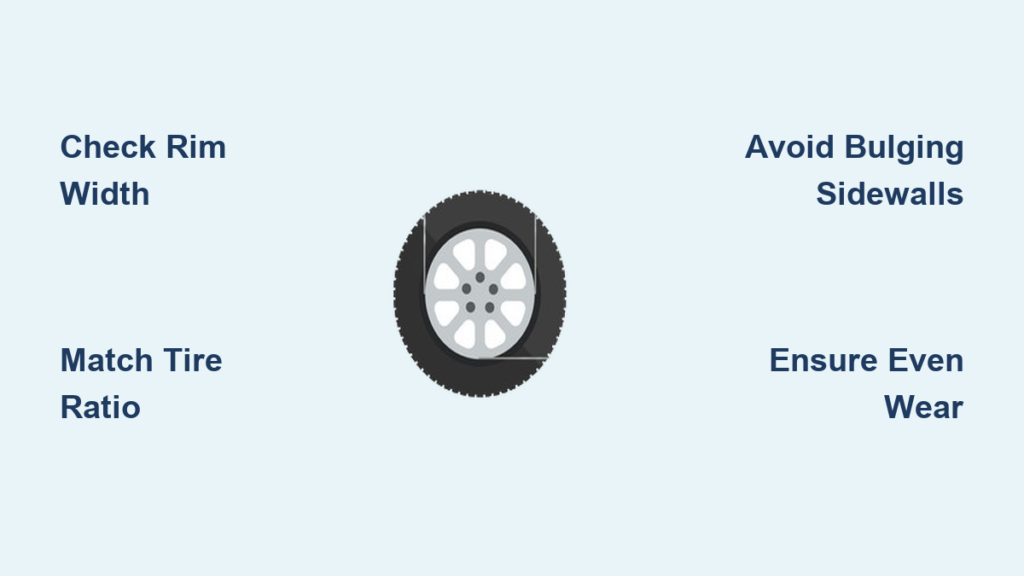
Tire manufacturers design each model to perform optimally within a specific rim width range—typically about 1 to 1.5 inches. Mounting a 225mm tire on a rim that’s too narrow creates excessive sidewall bulge, reducing stability during cornering and causing premature outer shoulder wear. Conversely, mounting that same tire on a rim that’s too wide creates an unnaturally flat tread profile that concentrates wear in the center while compromising grip during aggressive maneuvers.
The optimal width relationship follows a 70-85% ratio principle. For example, a 225mm tire (approximately 8.86 inches) works best on rims between 6.2 and 7.5 inches wide. This range allows the tire to maintain its engineered shape, ensuring even weight distribution across the entire contact patch. When this ratio is violated, you sacrifice the precise handling characteristics engineers designed into both your vehicle and tires.
Recognizing and Avoiding Dangerous Width Mismatches

Visible Signs of Improper Tire-Rim Width Pairing
Certain visual indicators immediately reveal width compatibility issues. A tire mounted on too narrow a rim will exhibit pronounced outward bulging along the sidewalls, creating an almost “balloon-like” appearance. This configuration reduces sidewall stiffness, leading to vague steering response and excessive body roll during cornering maneuvers. You might also notice the tire tread appearing slightly curved rather than flat when the vehicle is stationary.
When a tire mounts on a rim that’s too wide, the opposite occurs—the sidewalls pull inward toward the wheel center, creating a noticeable “bow” in the profile. This configuration leaves the outer edges of the tread unsupported, concentrating all road contact in the center portion of the tire. During driving, this mismatch often produces a harsh, choppy ride quality as the stiffened center section transmits every road imperfection directly to the vehicle’s suspension.
Performance Problems Caused by Width Incompatibility
Beyond visual indicators, width mismatches create measurable performance issues. A tire too wide for its rim develops delayed steering response because excessive sidewall flex absorbs driver inputs before translating them to road contact. This condition creates dangerous uncertainty during emergency maneuvers when precise handling is critical. The tire may also experience bead seating problems at high speeds or during aggressive cornering, potentially causing temporary air loss.
A tire too narrow for its rim generates excessive heat buildup during highway driving as the unsupported sidewalls flex repeatedly beyond design parameters. This condition accelerates internal component degradation and increases the risk of sudden tire failure. Additionally, the reduced contact patch width diminishes available traction during acceleration, braking, and cornering—particularly dangerous in wet conditions where hydroplaning risk increases significantly.
Practical Solutions for Proper Tire-Rim Width Matching
Consulting Reliable Fitment Resources
Your vehicle manufacturer’s specifications provide the safest starting point for tire and rim selection. Check your owner’s manual or driver’s side door jamb for factory-recommended tire sizes and rim widths. These specifications account for your vehicle’s weight distribution, suspension geometry, and safety systems calibration—factors that significantly impact how width mismatches affect overall performance.
For modified vehicles or non-standard applications, consult reputable fitment resources. Tire manufacturers publish width compatibility charts showing acceptable rim widths for each tire size they produce. Professional tire dealers also maintain extensive fitment databases that consider your specific vehicle make, model, and year. When in doubt, visit a specialty tire shop where technicians can physically verify compatibility before purchase.
Measuring Your Current Setup Correctly
Before purchasing new components, accurately measure your existing setup. Rim width appears stamped on the wheel’s interior surface in the format “7.5Jx18” where the first number indicates width in inches. Tire width displays as part of the size designation on the sidewall (e.g., 245/45R18). Record both measurements to ensure new components fall within acceptable compatibility ranges.
When measuring mounted tires, note that actual width varies slightly based on inflation pressure and rim width tolerance. A properly mounted tire should show minimal sidewall bulge or bowing when viewed from the front. The tread surface should appear relatively flat with only slight curvature—any pronounced distortion indicates width incompatibility requiring correction.
Special Considerations for Different Driving Applications
Performance and Track Driving Requirements
Performance applications often push width boundaries to maximize grip, but within carefully calculated parameters. Track-focused setups typically pair wider tires with appropriately wider rims to maintain proper width ratios while increasing contact patch area. These configurations require corresponding suspension modifications to accommodate the wider stance and altered geometry.
Street-driven performance vehicles benefit from staying within manufacturer width recommendations while selecting tires with appropriate performance ratings. Exceeding recommended width ranges without supporting modifications creates handling imbalances that compromise safety—particularly during emergency maneuvers where predictable response matters most.
Winter Tires and Seasonal Applications
Winter driving conditions sometimes benefit from narrower tire widths than standard setups. Narrower winter tires cut through snow more effectively and concentrate vehicle weight on smaller contact patches, improving traction in snowy conditions. When selecting winter tires, verify compatibility with your existing rims or consider dedicated winter wheels in appropriate widths.
All-season tires typically offer wider acceptable rim width ranges than performance-oriented summer tires due to their versatile design. However, maintaining proper width ratios remains essential for even wear and predictable handling across varied conditions. Seasonal tire changes present an excellent opportunity to verify width compatibility before installation.
Maintaining Optimal Width Relationships for Safety and Longevity
Regular Inspection and Maintenance Practices
Inspect tire-rim relationships during routine maintenance by checking for visible sidewall deformation and proper tread contact. An improperly matched setup shows uneven wear patterns within the first few thousand miles—shoulder wear indicates a tire too wide for the rim, while center wear suggests the opposite problem.
Maintain manufacturer-recommended inflation pressures consistently, as improper pressure exacerbates width mismatch issues. Check tire pressure monthly and before long trips using a quality gauge. Proper inflation helps maintain the designed contact patch regardless of width compatibility, though it cannot correct fundamental mismatch problems.
Smart Replacement Strategies
When replacing tires, verify new selections match existing rim widths appropriately. Mixing different width tires across axles creates dangerous handling imbalances, particularly in front-wheel-drive vehicles where front tire characteristics significantly influence steering response. Always replace tires in pairs on the same axle, preferably all four simultaneously for optimal performance.
Consider dedicated wheel sets for specialty applications like winter driving. While this represents an additional investment, properly matched tire-wheel combinations for each season maximize performance, safety, and component longevity. The initial cost often pays dividends through extended tire life and improved driving confidence.
Key Takeaways for Safe and Effective Tire-Rim Width Matching
Does tire width matter for rims? Absolutely—it’s a critical factor affecting your vehicle’s safety, performance, and operating costs. Proper width matching ensures your tires maintain their engineered shape, providing predictable handling, even wear, and optimal traction in all driving conditions. Ignoring width compatibility creates preventable safety hazards and unnecessary expenses through premature tire replacement.
When selecting new tires or wheels, prioritize compatibility over aesthetics alone. Consult manufacturer specifications, verify measurements, and seek professional advice when uncertain. Proper tire-rim width matching represents an investment in your safety and driving experience that pays dividends throughout your tires’ service life. The time spent ensuring correct fitment today prevents dangerous situations and costly mistakes tomorrow—making it one of the most important vehicle maintenance decisions you’ll make.