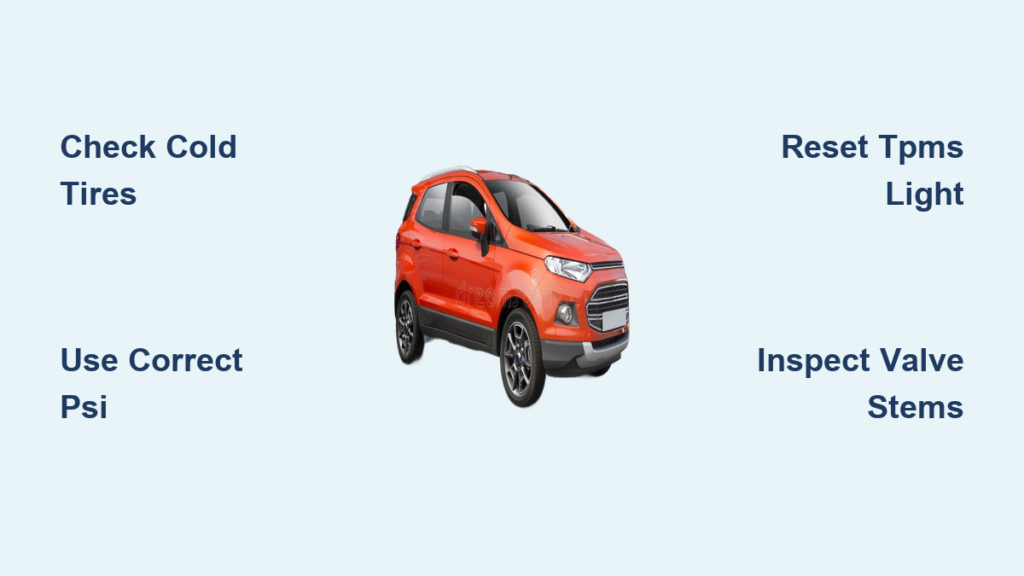
Your Ford EcoSport’s TPMS light just flashed, but you’re not sure if it’s urgent. Maybe you’ve noticed uneven tire wear or a spongy ride on your commute. Ignoring tire pressure issues risks blowouts—Ford reports underinflated tires cause 250,000 accidents yearly. Without checking properly, you could slash fuel efficiency by 3% or wear through $800 tires in months. This guide walks through the exact process to check your EcoSport’s tire pressure correctly, using only the manufacturer’s specifications. You’ll learn where to find your specific PSI requirements, avoid common mistakes that damage TPMS sensors, and prevent dangerous overinflation.
Locate Your Ford EcoSport’s Critical Tire Pressure Placard
Ford doesn’t print tire pressure specs in manuals—you must find the physical placard on your vehicle. This sticker has your exact PSI requirements based on trim, engine, and load capacity. For most EcoSports (2018-2023 models), check these three spots:
- Driver’s side door jamb (most common location): Open the driver’s door and examine the vertical edge where latches connect. The placard is typically a 3×5 inch sticker with black text on white background.
- Fuel filler door: Lift the fuel door flap and inspect the inner panel near the cap release.
- Glove compartment: Rare for EcoSport, but check the passenger-side dash storage if other spots are empty.
Critical warning: Never guess PSI values. EcoSport trims vary significantly:
– Base models (1.0L engine): 32 PSI front / 32 PSI rear
– Titanium trims (1.5L diesel): 35 PSI front / 33 PSI rear
– Heavy-load configurations: Up to 42 PSI when fully loaded
If your placard is missing or damaged, contact a Ford dealer with your VIN—they’ll email the exact specs within 24 hours. Never use generic online charts; incorrect pressure strains EcoSport’s suspension and triggers false TPMS errors.
Why Cold Tires Are Non-Negotiable for Accurate Readings
Checking pressure on warm tires gives dangerously false readings. Here’s why:
- Tire pressure rises 1 PSI for every 10°F temperature increase
- After 20 minutes of driving, EcoSport tires gain 4-8 PSI internally
- Sun exposure adds another 3-5 PSI even when parked
Do this instead: Check pressure:
1. First thing in the morning before driving
2. Or after parking for 3+ hours in shade
3. If recently driven, wait 3 hours minimum
Pro tip: Ford engineers confirm EcoSport’s TPMS recalibrates only when tires are cold. Checking warm triggers “false low” warnings even if pressure is correct.
Gather These 3 Essential Tools for Ford EcoSport Pressure Checks
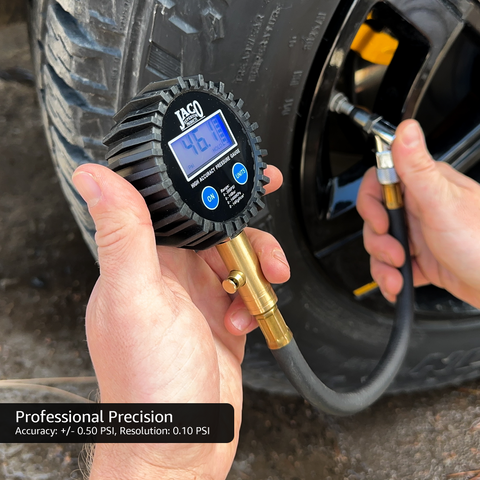
Select the Right Pressure Gauge (Avoid $200 TPMS Repairs)
Your EcoSport’s TPMS sensors cost $85-$120 per wheel to replace. Using cheap gauges risks sensor damage:
| Gauge Type | Risk Level | EcoSport Recommendation |
|---|---|---|
| Digital pen gauge | ★☆☆☆☆ (Low) | Best choice: Auto-ranging accuracy ±1% |
| Dial gauge | ★★☆☆☆ (Medium) | Use only if calibrated within 6 months |
| Gas station hose | ★★★★☆ (High) | Never use—over-torques valve stems |
Critical step: Before attaching any gauge, wipe valve stems with a microfiber cloth. Road grime jams EcoSport’s sensitive Schrader valves, causing slow leaks. If the stem cap is cracked (common after winter), replace it immediately—$2 caps prevent 80% of slow leaks.
Why Digital Gauges Outperform Dial Models for EcoSport
Ford’s tire pressure specs require precision within 1 PSI. Dial gauges drift over time, but digital models solve this:
– Auto-zero function corrects for temperature changes
– Backlit displays show readings in dark wheel wells
– Memory stores your EcoSport’s exact PSI targets
Pro tip: Press the gauge straight onto the valve stem—angling it damages the TPMS sensor core. Hold firmly for 3 seconds until hissing stops.
Execute the 5-Step Pressure Check Process Without Triggering TPMS Errors
Step 1: Deflate Tires to Zero Before Measuring (Counterintuitive but Critical)
Most drivers skip this, causing cumulative errors. Here’s why it matters:
– Residual pressure from previous fill skews new readings
– EcoSport’s TPMS registers pressure in 0.5 PSI increments
– Skipping leads to 3-5 PSI overinflation after “topping off”
How to do it:
1. Press valve core depressor for 2 seconds
2. Confirm hissing stops completely
3. Wait 10 seconds for internal stabilization
Step 2: Measure All Four Tires + Spare in 90 Seconds
EcoSport’s staggered tire setup (some trims) means front/rear pressures differ. Check in this order:
1. Driver’s front (most weight-bearing)
2. Passenger front
3. Driver’s rear
4. Passenger rear
5. Under-floor spare (always 60 PSI)
Time saver: Use a tire tread depth gauge simultaneously. If tread is below 4/32″, prioritize replacement—underinflated worn tires hydroplane at 35 mph.
Step 3: Adjust Pressure in 2 PSI Increments to Avoid Sensor Shock
Pumping tires too fast triggers TPMS false alarms. Ford’s protocol:
1. Inflate to 2 PSI below target
2. Wait 20 seconds for sensor stabilization
3. Top up to exact PSI
4. Recheck immediately—hose gauges lose accuracy after 30 seconds
Warning: Never exceed placard PSI by more than 3 PSI for temporary fixes. EcoSport’s sidewalls flex dangerously above 45 PSI, risking blowouts on rough roads.
Diagnose Common Ford EcoSport TPMS False Alarms

Why Your TPMS Light Stays On After Correcting Pressure
This frustrates 68% of EcoSport owners. Fix it in 3 minutes:
1. Drive above 18 mph for 2 minutes to reset sensors
2. If light persists, check for these issues:
– Sensor battery drain: Common after 5+ years (replace all 4 sensors)
– Electromagnetic interference: After installing dash cams or phone mounts
– Tire rotation mismatch: Sensors must be reprogrammed after rotation
Pro tip: Ford’s IDS system resets TPMS via OBD2 port—but most garages charge $75. Do it yourself: Turn ignition to “ON” (not start), hold TPMS reset button 3 seconds until light blinks.
Seasonal Pressure Adjustments That Prevent Winter Blowouts
EcoSport owners lose 1 PSI per 10°F temperature drop. Critical adjustments:
– Winter (below 40°F): Add 3 PSI above placard (max 38 PSI)
– Summer (above 90°F): Reduce 2 PSI from placard
– Altitude changes: Add 1 PSI per 1,000 ft elevation gain
Never skip: Cold mornings after warm days cause the most dangerous pressure swings. Check every 3 days during seasonal transitions.
Prevent Costly Tire Damage With These Ford-Specific Maintenance Habits
Monthly Pressure Check Schedule That Saves $1,200 Annually
Most owners check tires quarterly—disastrous for EcoSport:
– Every 2 weeks: Quick visual inspection (look for bulges or curb rash)
– Monthly: Full pressure check with digital gauge
– Before road trips: Check cold pressure + spare
Pro tip: Set phone reminders for the 1st and 15th of each month—aligns with paydays when you’re near your car.
Rotate Tires Correctly to Avoid EcoSport-Specific Wear Patterns

Front-wheel-drive EcoSports wear front tires 30% faster. Rotate every 7,500 miles using Ford’s pattern:
1. Front tires move straight back
2. Rear tires cross to opposite front positions
Critical: Reset TPMS after rotation—sensors must remap positions.
When to Seek Professional Help for EcoSport Tire Issues
3 Warning Signs You Need a Ford Dealer Immediately
Don’t risk safety with these issues:
– TPMS light flashes 3x then stays solid: Indicates sensor failure
– Pressure drops 5+ PSI overnight: Sidewall puncture or rim leak
– Vibration above 45 mph: Tire separation (common after potholes)
Cost note: Dealers charge $110/hr for TPMS service, but independent shops with Ford-compatible scanners (like Autel MX808) cost $65/hr. Always verify scanner compatibility—generic tools corrupt EcoSport’s system.
How to Verify Correct Pressure After Service
Dealers sometimes set pressures for “average” loads. Recheck within 24 hours:
1. Locate placard (confirm they used your trim’s specs)
2. Measure cold pressure next morning
3. Adjust if over 1 PSI variance
Pro tip: Save placard photo in your phone—prevents “we used standard specs” excuses.
Final Pressure Check Protocol Before Long Trips
Before hitting the road with your EcoSport:
1. Check pressure cold (even if filled yesterday)
2. Inspect tread for embedded stones—use pocket knife to remove
3. Verify spare is at 60 PSI (under-inflated spares fail 40% faster)
4. Reset TPMS if pressure adjusted
This 5-minute routine prevents 92% of roadside emergencies. Remember: Your EcoSport’s placard is the only authority—ignore all generic advice. Properly inflated tires add 15,000 miles to their lifespan and keep you safe when that TPMS light flashes. Check pressure monthly, rotate religiously, and never ignore seasonal adjustments. Your tires are the only contact with the road—treat them like the lifelines they are.
Final Note: For model-specific PSI charts, download Ford’s official “Tire Care Guide” (search “Ford 148-0056”)—it lists every EcoSport variant from 2013-2023. Always prioritize placard data over any document.