That annoying amber warning light on your Hyundai Kona’s dashboard won’t disappear even though you know your tires are properly inflated. The Tire Pressure Monitoring System (TPMS) is designed to keep you safe by alerting you when tire pressure drops below optimal levels, but when it stays illuminated after you’ve corrected the pressure, it creates unnecessary stress. Knowing how to reset the tire pressure sensor on your Hyundai Kona is essential for maintaining both vehicle performance and your peace of mind. The good news is you don’t need a dealer visit—several effective reset methods work right from your driver’s seat.
When your Kona’s TPMS light illuminates, it typically means one or more tires have fallen below the manufacturer’s specified threshold (usually below 25 PSI). After inflating your tires to the recommended 33 PSI, you must help the system recognize the correct readings—otherwise, that warning light stays on. This guide covers every proven reset method for your Hyundai Kona, from simple menu-based procedures to troubleshooting steps for stubborn warning lights that refuse to clear after standard attempts.
Steering Wheel Menu Reset Steps

The most reliable method for resetting your Kona’s TPMS uses your steering wheel controls and instrument cluster menu—this official Hyundai procedure works across all model years with digital displays and should be your first attempt.
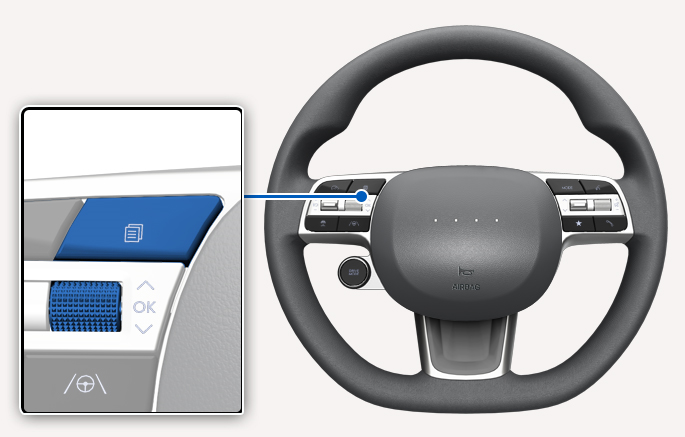
Start by confirming all four tires match the recommended pressure specified on your driver’s side door jamb sticker—typically 33 PSI for both front and rear tires. With your Kona parked and engine off, press the “OK” or “SET” button on your steering wheel to access the main menu. Use the navigation switches (usually up/down arrows) to scroll until you see “Tire Pressure” or “TPMS” on your instrument cluster.
Once selected, press and hold the OK button for 2-3 seconds. The system will prompt you to confirm the reset, displaying “Set” or “Confirm.” After selecting this option, watch for the TPMS warning light to blink for about four seconds—this confirms the system has accepted your reset command. If you don’t see the “Tire pressures stored” message or the warning light doesn’t blink, repeat the procedure, ensuring you hold the button long enough and that all tires are at the correct pressure first.
Ignition Switch Reset Procedure
For Kona models without the steering wheel menu option, or when the menu-based method doesn’t work, the ignition switch reset offers a dependable alternative that works on most Hyundai vehicles.
Turn your ignition to the “On” position without starting the engine. Locate the TPMS reset button under the steering column near your left knee—this small button is often hidden from view. Press and hold it until the TPMS warning light begins to flash, typically three quick flashes. Release the button immediately when you see these flashes.
After releasing the button, start your vehicle and let it run for 20 minutes. During this time, the system recalibrates and stores the current tire pressure readings. The warning light should extinguish automatically once the system confirms all pressures are within range. Don’t skip this 20-minute running period—disconnecting before completion may prevent the system from clearing the warning light.
Drive-Based Recalibration Guide
The Hyundai Kona includes an automatic relearn function that resets the TPMS during normal driving, making this method the most convenient option when other procedures fail.
After verifying all tires are properly inflated to 33 PSI, simply drive your vehicle for 10-20 minutes at speeds of 12 mph or higher. The system automatically detects and registers current pressure readings during this drive cycle. Many Kona owners report success after 15-20 minutes of driving—one forum member confirmed their TPMS light “never reset until after driving for about 15–20 minutes following the prescribed steps.”
For optimal results:
– Include driving at higher speeds (around 50 mph) for at least 10 minutes
– Make several stops and starts during the recalibration period
– Ensure tires have adequate time to warm up from normal driving
Battery Disconnect Method
When all other methods fail to reset the stubborn TPMS light, a battery disconnect procedure can force a complete system reset by draining residual power from your vehicle’s electrical systems.
Begin by turning off your Kona completely. Open the hood and disconnect the positive battery cable (red cable) using a wrench. With the cable disconnected, turn the ignition to “On” and honk the horn continuously for 3-5 seconds to drain remaining power.
After honking, turn the ignition back to “Off,” reconnect the positive battery cable, and start your vehicle. Check whether the TPMS warning light has disappeared. Use this method as a last resort since it will also reset your radio presets, clock, and other vehicle preferences. If the light returns shortly after, you likely have an underlying issue needing further diagnosis.
Infotainment System Reset

Newer Hyundai Kona models (2022-and-newer and Kona Electric) offer a TPMS reset option through the infotainment system settings menu—a straightforward alternative for drivers comfortable with the touch interface.
Access settings by pressing the “Setup” button on your infotainment screen. Navigate to “Vehicle,” “Driver Assistance,” or “TPMS” sections. Look for options labeled “Reset TPMS,” “Recalibrate TPMS,” or similar phrasing. Select this option and follow on-screen prompts to confirm the reset.
After confirming, the system may require driving for a certain distance before completion. The screen might display a confirmation message or progress indicator. If you don’t see a TPMS reset option, your model may not support this feature—revert to other reset methods instead.
Overinflation-Deflation Technique
A less conventional but frequently effective method for resetting stubborn TPMS systems involves deliberately overinflating and then deflating your tires to force recalibration.
Begin by inflating all four tires to approximately 3 PSI above recommended pressure (about 36 PSI instead of 33 PSI). After reaching this overinflated state, deflate all tires completely by removing the valve core from each valve stem until nearly flat. Important: Don’t deflate so much that you risk damaging tires or rims.
Once deflated, reinflate all tires to the correct 33 PSI. After completing this process, drive your vehicle for several miles at various speeds. The dramatic pressure changes often cause the TPMS system to recognize a reset has occurred and clear the warning light—particularly useful when other procedures fail despite correct inflation.
Troubleshooting Persistent TPMS Issues
Sensor Battery Failure
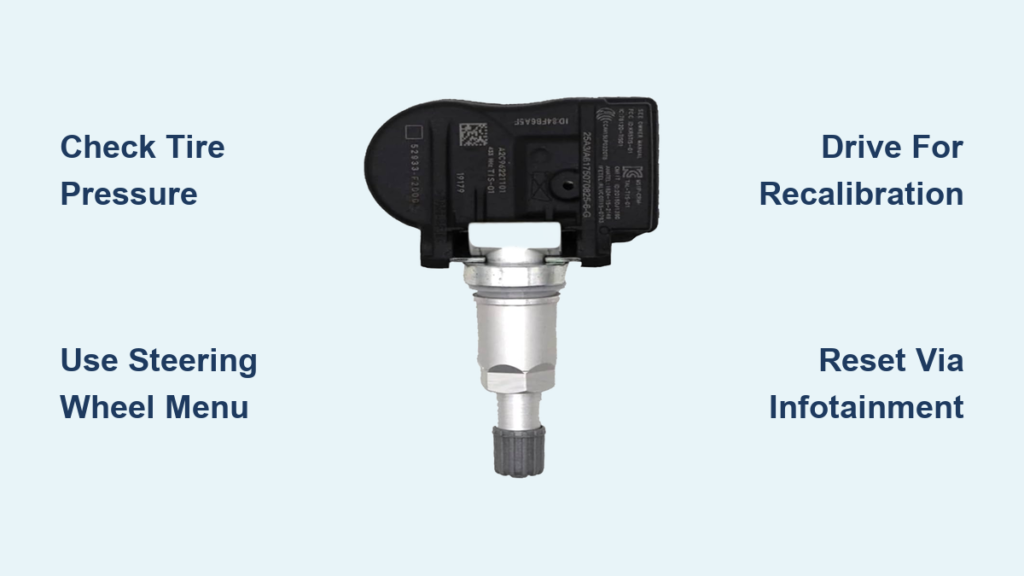
A common cause of TPMS lights that won’t reset is a failed sensor battery. Lithium-ion batteries inside TPMS sensors typically last 5-10 years but can fail prematurely due to corrosion or water damage. When a sensor battery fails, it stops transmitting pressure data, causing the warning light to illuminate.
If your TPMS light is flashing rather than solid, this typically indicates a sensor malfunction. A flashing light means the system receives no signal from one or more sensors. In this case, you’ll need professional diagnosis to identify and replace the specific faulty sensor.
Temperature Effects on TPMS
Temperature changes significantly affect tire pressure and can trigger the TPMS light. For every 10°F drop in temperature, tire pressure decreases by approximately 1 PSI. This explains why TPMS lights often appear during cold winter mornings.
If your TPMS light comes on during temperature changes but turns off after driving, this is normal behavior. However, if you need to add air frequently, you may have a slow leak requiring inspection. Some Kona owners report needing to inflate slightly above the recommended pressure (35-36 PSI) for the TPMS to register correctly.
Professional Diagnosis and Help
While most TPMS issues resolve with the methods above, certain situations require professional diagnosis. If your TPMS light continues illuminating despite correct pressures and multiple reset attempts, seek professional help. Similarly, if the light flashes continuously rather than staying solid, this indicates a sensor or module failure needing technical expertise.
A Hyundai dealer has specialized diagnostic equipment that communicates directly with the TPMS control module, identifying specific sensor failures. For independent shops, look for one with TPMS diagnostic capabilities and Hyundai experience. Always confirm the shop has experience with your specific vehicle before authorizing repairs.
Preventing Future TPMS Problems
Regular tire inspection and maintenance prevents most TPMS issues. Inspect your Kona’s tires every two weeks for visible damage like cuts, bulges, or embedded objects. Check valve stems for damage or corrosion and ensure valve caps are tight.
Monitor tire pressure monthly using your own reliable gauge—gas station meters can be inaccurate. Check pressure when tires are cold for the most accurate reading. When having tires serviced, remind technicians about your TPMS sensors and ask them to handle sensors with care.
When sensor replacement becomes necessary, using Original Equipment Manufacturer (OEM) sensors is strongly recommended. Aftermarket sensors may be incompatible with your Kona’s TPMS system, leading to false warnings or no warning at all. OEM sensors communicate properly with your vehicle’s TPMS control module, providing reliable performance despite the higher upfront cost.