Ever wonder why your tractor struggles in wet fields while your neighbor’s powers through with ease? The answer often lies in your tractor tire types. Selecting the proper agricultural tires directly impacts your fuel efficiency, soil health, and ultimately your bottom line. With multiple classification systems governing tread patterns, depth, and application-specific designs, choosing the right tires becomes a critical decision that affects every aspect of your farming operation. This guide breaks down each major tire classification so you can match the perfect tread pattern to your specific soil conditions, equipment requirements, and operational needs—saving you money while protecting your valuable soil resources.
R-1 Tires: Why Your Standard Farm Tractor Needs This Tread Pattern

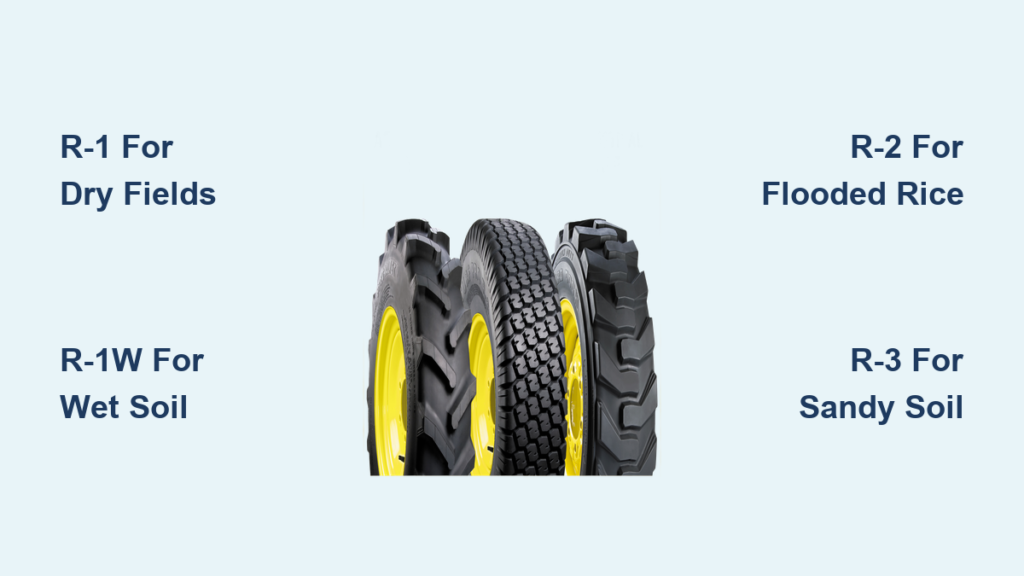
When your tractor exceeds 100 horsepower and handles general farming tasks, R-1 tires deliver the optimal balance of traction and soil preservation you need for day-to-day operations. These tires feature lug patterns with precisely engineered depth and aggressive angles that self-clean during rotation—preventing mud buildup that would otherwise reduce traction and increase fuel consumption during critical planting or harvesting windows.
Critical visual cue: Look for lugs that measure approximately 1.5 times the width of the tread gap between them—this ratio creates the ideal self-cleaning action while maintaining sufficient soil penetration for reliable power transmission. The R-1 tread pattern works exceptionally well when mounted on combines and sprayers where consistent traction directly impacts your harvesting efficiency and chemical application accuracy.
When R-1 Tires Fail Your Operation (And How to Prevent It)
Common mistake: Using R-1 tires in consistently wet conditions where they can’t reach firm soil layers. When upper soil horizons become saturated, these tires lose their grip, causing wheel slippage that wastes 15-20% more fuel while damaging your soil structure through excessive compaction.
Pro tip: Pair R-1 drive tires with F-2 three-rib steer tires to create a balanced system that maintains predictable handling during both field operations and highway transport. The complementary tread depths ensure your steering remains responsive even when drive tires are working hard in challenging terrain.
R-1W Tires: How Deep Tread Solves Wet Field Problems
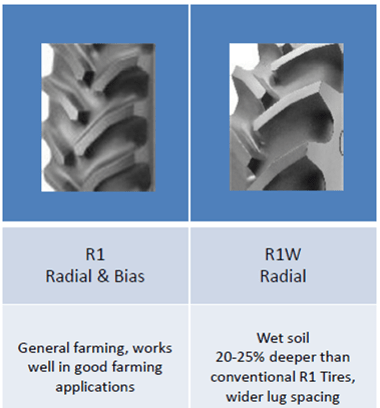
If you’ve ever watched your tractor wheels spin helplessly in spring planting conditions, R-1W tires offer the 20% deeper lug depth you need to penetrate surface moisture and reach firm soil layers beneath. This “deep tread” variant provides measurable traction improvements in challenging soil conditions that would render standard R-1 tires nearly ineffective during critical planting windows.
Key visual indicator: When comparing R-1W tires to standard R-1 models, notice the significantly expanded groove volume between lugs—this extra space allows accumulated mud to discharge completely during each rotation cycle, maintaining consistent traction as conditions change throughout the day.
Regions That Benefit Most From R-1W Tread Depth
Farmers operating in areas with higher annual precipitation, naturally high water tables, or early-season planting requirements see the greatest return on investment with R-1W tires. The enhanced self-cleaning properties become particularly valuable when working in clay-rich soils that tend to cling to standard tire treads.
Warning: Don’t assume R-1W is always better—using these deeper-tread tires on well-drained soils creates unnecessary rolling resistance that reduces fuel efficiency by 5-8% compared to properly matched R-1 tires. Evaluate your typical field conditions before upgrading.
R-2 Tires: When “Rice and Cane” Tread Saves Your Harvest
When water stands continuously at or near the soil surface during rice or sugarcane harvesting, only R-2 tires with their extraordinary tread depth—measuring at least twice that of standard R-1 tires—can transmit engine power effectively through the water layer to grip underlying soil. This specialized tread pattern represents the extreme end of moisture tolerance among agricultural drive tires.
Real-world application: Rice farmers who switch from R-1W to R-2 tires during the final flooding stages of rice production report up to 30% reduction in wheel slippage, translating directly into faster harvest times and less crop damage from equipment getting stuck.
The Hidden Cost of R-2 Tires You Must Consider
While R-2 tires solve extreme wet condition challenges, their substantial rubber mass creates significantly increased rolling resistance that impacts your fuel budget. Expect 10-15% higher fuel consumption compared to R-1W tires during extended operating periods—a trade-off that makes economic sense only when operating in permanently saturated conditions.
Pro tip: Reserve R-2 tires for equipment dedicated to flooded field operations rather than using them across your entire fleet. This targeted approach maximizes their specialized capabilities while minimizing unnecessary fuel expenses.
R-3 Tires: How Shallow Tread Protects Sandy Soils
If your farm operates primarily in sandy soils or volcanic ash regions, R-3 tires with their minimal tread depth—approximately half that of standard R-1 tires—prevent excessive ground disturbance that could damage delicate soil structures. The shallow lug design reduces the risk of creating deep ruts while maintaining sufficient traction for normal field operations.
Visual confirmation: When inspecting R-3 tires, notice how the lugs barely protrude from the tire base compared to aggressive agricultural treads—this subtle profile creates the minimal soil interaction required for sensitive soil types without sacrificing necessary grip.
Why R-3 Tires Fail in Standard Field Conditions
Critical mistake: Using R-3 tires in typical loam or clay soils where their shallow tread can’t penetrate surface layers. In these conditions, wheel slippage increases dramatically during powered operations, leading to reduced efficiency and potential crop damage from excessive tire spin.
Expert insight: R-3 tires excel on older grain carts crossing sandy fields where reduced rolling resistance improves transport efficiency. However, they’re completely unsuitable for tractors performing primary tillage operations in standard agricultural soils.
F-2M Steer Tires: Multi-Rib Design for Precision Farming
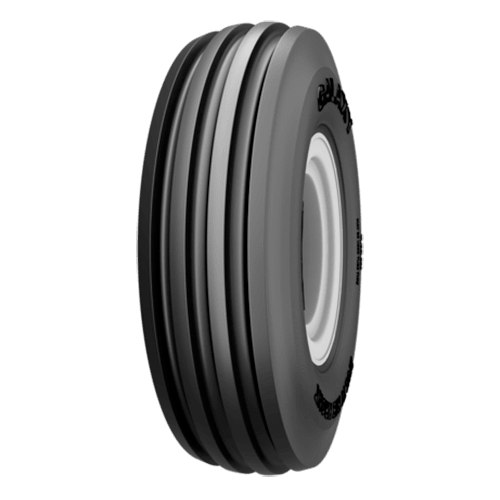
When your operation requires frequent tight turns in orchards, vineyards, or precision planting applications, F-2M steer tires deliver the enhanced directional control you need through their multi-rib configuration. The additional circumferential ribs distribute steering forces across a larger tread area, providing consistent handling characteristics throughout the tire’s service life.
Immediate benefit: Upgrading from standard F-2 to F-2M tires reduces steering effort by up to 25% during frequent headland turns, decreasing operator fatigue during long field days while improving implement placement accuracy.
How to Identify When You Need F-2M Tires
Signs you need multi-rib steer tires:
– Your tractor exhibits inconsistent steering response during tight maneuvers
– You notice uneven wear patterns on standard three-rib steer tires
– Your operation involves frequent implement hookups requiring precise positioning
– You’re working in specialty crops requiring sub-inch placement accuracy
Warning: Never mix different steer tire types on the same axle—this creates unpredictable handling that could lead to dangerous situations during high-speed transport or sudden maneuvers.
I-3 Implement Tires: Maximize Traction on Self-Propelled Equipment
For self-propelled sprayers, forage harvesters, and other ground-powered equipment, I-3 implement tires with their bar-type tread patterns provide the critical traction you need to prevent wheel slippage during acceleration or braking. These tires transmit significant driving forces through the implement’s drivetrain without damaging soil structure through excessive spin.
Visual difference: Unlike rib-tread I-1 implement tires, I-3 tires feature aggressive bar patterns similar to R-1 drive tires—but engineered specifically for the unique loading characteristics of implement axles.
Why I-3 Tires Outperform I-1 on Powered Implements
Key advantage: I-3 tires maintain consistent traction when operating on slopes or in moist conditions where rib-tread implement tires would spin uselessly. This reliable grip prevents the uneven application rates that occur when self-propelled sprayers lose traction during chemical application.
Pro tip: Pair I-3 implement tires with appropriately matched R-1 or R-1W drive tires to create a unified traction system that maximizes efficiency across your entire equipment fleet.
High Flotation Tires: Reduce Soil Compaction by 40%
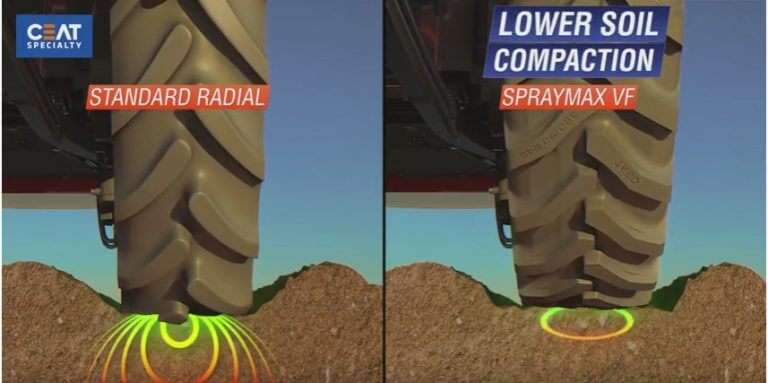
When soil compaction threatens your crop yields, HF-series high flotation tires distribute equipment weight across larger surface areas, reducing ground pressure by up to 40% compared to standard agricultural tires. HF-1 through HF-4 classifications represent progressively greater flotation capabilities, with HF-4 tires offering maximum ground contact area for operations where soil protection takes absolute priority.
Immediate visual indicator: High flotation tires appear significantly wider and often taller than standard agricultural tires of equivalent load capacity—their expanded footprint is immediately noticeable when comparing side by side.
When High Flotation Tires Pay for Themselves
Economic benefit: Farms operating in wet soil conditions, sensitive crop stages, or requiring multiple passes across the same field see yield increases of 5-10% from reduced soil compaction—easily offsetting the initial tire investment within 2-3 growing seasons.
Critical consideration: High flotation tires require specialized rims and often lower inflation pressures—consult your tire dealer to ensure proper setup that maximizes their soil-protecting benefits without risking tire damage.
How to Match Tractor Tire Types to Your Specific Farm Conditions
Selecting the right tractor tire types requires evaluating your unique combination of soil conditions, equipment specifications, and operational requirements—not simply copying what your neighbor uses. This strategic approach ensures you maximize efficiency while protecting your soil resources.
Step-by-Step Tire Selection Process
- Analyze your predominant soil moisture conditions—choose R-1 for well-drained soils, R-1W for moderate moisture, or R-2 for permanently saturated fields
- Evaluate your primary equipment applications—match drive tires to specific tasks (tillage, harvesting, spraying)
- Calculate actual load requirements—select tires based on verified weight loads at appropriate inflation pressures
- Create a balanced tire system—ensure steer, drive, and implement tires work together harmoniously
Critical mistake to avoid: Under-inflating tires to increase footprint—this creates excessive sidewall flex that accelerates wear and can lead to catastrophic tire failure. Always follow manufacturer inflation guidelines based on your actual load weights.
Final Note: Your tire selection directly impacts fuel efficiency, soil health, and ultimately your profitability—treat it as the strategic decision it truly is. By matching the right tractor tire types to your specific conditions, you’ll reduce operating costs while protecting your most valuable asset: the soil itself. For operations with diverse field conditions, consider maintaining specialized tire sets for different seasonal requirements rather than compromising with a one-size-fits-all approach.